Temperature23 – 29 °C
Natural range
- Loreto Region
- Upper Amazon area
CichlidsConservation status: Least concern LC
The High-fin Apistogramma (Apistogramma eunotus), a representative of the Cichlidae family, is one of the popular South American cichlids. Its keeping does not present particular difficulties for experienced aquarists, who can also manage its breeding. However, novice aquarists may encounter certain challenges, especially during the spawning period, when males exhibit complex behavior.
- Required aquarium volume
- 40 L
- Size in aquarium
- 4 – 5 cm
- Temperature
- 23 – 29 °C
- Temperament
- Semi-peaceful (including aggression during spawning / intraspecific conflicts)
Parameters
Water pHSlightly acidic (5.5) – Neutral (7)
Water dHVery soft (0) – Soft (5)
Water salinityno salt (freshwater)
Size in aquarium4 – 5 cm
Lifespan4 years
TemperamentSemi-peaceful (including aggression during spawning / intraspecific conflicts)
Toward small fishnot a predator
Required aquarium volume40 L
Lightingdimmed
Substratesandy (regular, light)
Water flowweak
FeedingHigh protein (predominantly meat)
CareHarem (1 male and several females)
Description
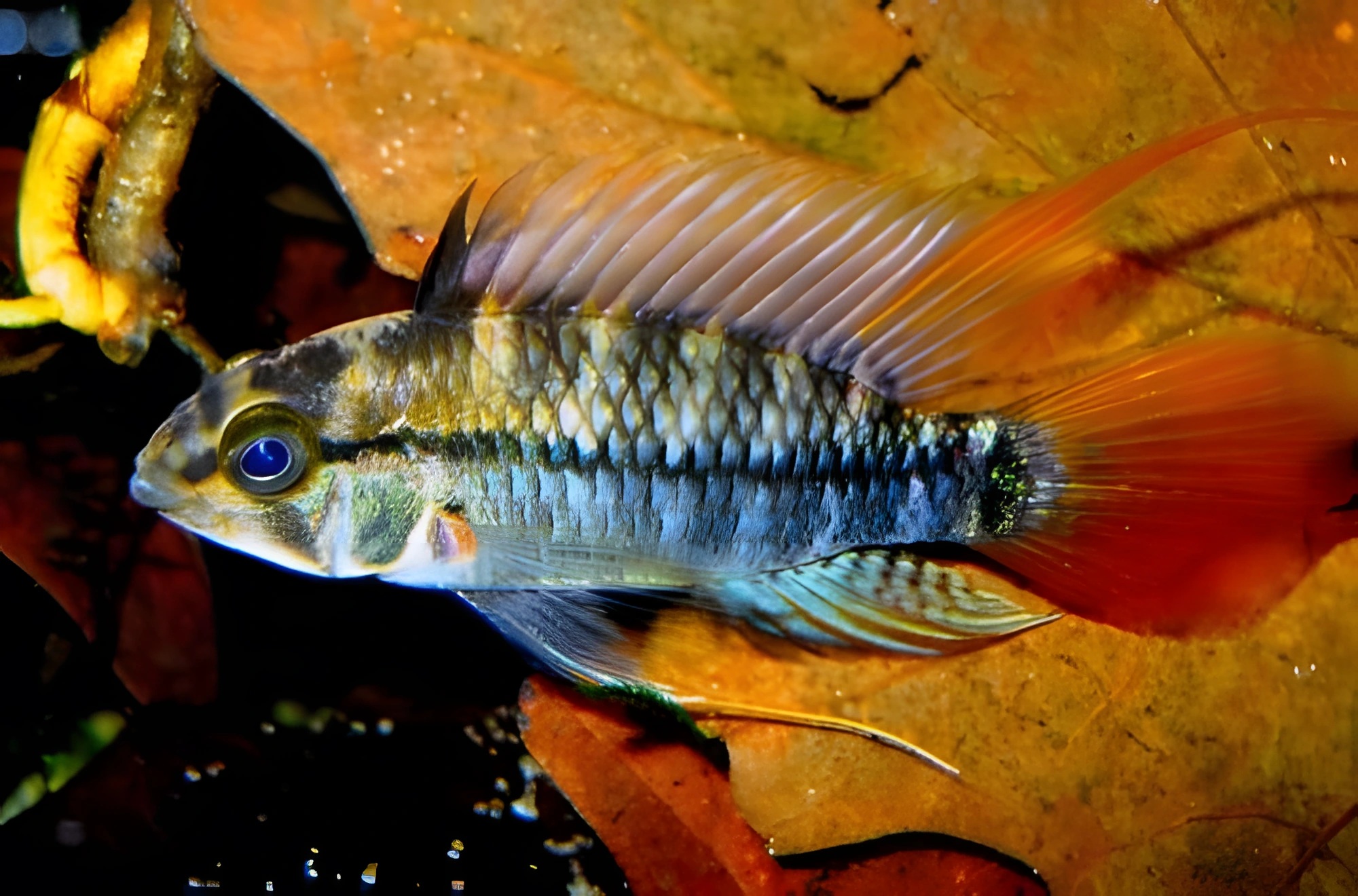
Adults reach a length of 4–5 cm, with males being larger than females. The coloration of males is dominated by blue and light blue hues, complemented by a red tail. They also have elongated last rays of the dorsal and ventral fins. Dominant males are distinguished by brighter coloration and even longer fin rays. Females, on the other hand, are smaller and yellow in color. Their bodies display a pattern of several dark, large spots along the lateral line, and a diagonal black stripe runs across their heads.
Habitat
The natural range of this species covers South America, including eastern Peru (Ucayali River basin) and the western part of Brazil (Solimões River basin). These areas are part of the region known as the Upper Amazon. The fish inhabit numerous rivers and streams hidden under the dense canopy of the tropical forest, preferring areas with slow currents. Their natural biotopes feature an abundance of snags and fallen leaves, which release tannins during decomposition. This gives the water a characteristic brownish tint while maintaining its transparency.
Behavior and Compatibility
The High-fin Apistogramma can live both alone and in a group. When kept in a group, especially in a small aquarium, it should be remembered that males can exhibit fierce competition with each other. Therefore, it is recommended to maintain a group composition consisting of one male and one or more females. Another behavioral peculiarity manifests during the spawning period: the male shows too much attention to the female even after the eggs have been fertilized. If the female does not have an opportunity to hide in such a situation, the consequences can be quite dire.
Care and Maintenance
For keeping a pair of these fish, an aquarium of at least 40 liters will be required. It is important to decorate it in such a way as to create conditions that closely resemble their natural habitat. It is recommended to use a soft substrate, such as sand, and to add many snags and live or artificial plants. Lighting should be subdued. In addition, it is necessary to provide a sufficient number of shelters where the fish can find refuge, which is especially important during the spawning period when the male may actively pursue the female. Experienced aquarists often add dried leaves from certain trees. During decomposition, they release tannins, which acidify the water and color it a characteristic brown, helping to recreate the hydrochemical composition of the natural waters where Apistogramma eunotus lives. More details on this can be found in the article “What tree leaves can be used in an aquarium”. For successful and long-term keeping of these cichlids, maintaining stable water parameters is key: temperature, hydrochemical composition, and low concentrations of nitrogen cycle products (ammonia, nitrites, nitrates). This requires regular procedures: weekly partial water changes, timely removal of organic waste (excrement, food remnants, biofilm), and monitoring of equipment condition. It is also critically important to regularly check water parameters. The filtration system plays an important, and perhaps decisive, role. Before choosing a specific filter model, it is advisable to consult with a specialist who can help select a suitable option based on the aquarium volume and the number of inhabitants.
Diet
The diet for these fish should consist of protein-rich foods. Both dry foods, such as flakes or granules, and live or frozen daphnia, bloodworms, and brine shrimp can be used as food.
Breeding and Reproduction
Under favorable conditions, the likelihood of fry appearing is quite high. During the spawning period, the female lays her eggs in a secure shelter, remaining near the clutch until the offspring hatch. After the fry emerge, she continues to care for them for some time. In a small aquarium, it is advisable to temporarily move the male to a separate tank.
Diseases
The main cause of diseases often lies in the keeping conditions: if they go beyond acceptable limits, immunity decreases, making the fish vulnerable to various infections inevitably present in the environment. At the first suspicion of illness, it is important first of all to check the water parameters and ensure there are no dangerous concentrations of nitrogen cycle products. Often, restoring normal, suitable conditions promotes recovery. However, in some cases, medication may be required. Detailed information on symptoms and treatment methods is presented in the "Aquarium Fish Diseases" section.
How to choose
When purchasing, choose active fish with clean fins and no body damage. Avoid individuals with sunken bellies or signs of film on their scales, as this may indicate hidden diseases. In the store, the fish should show natural curiosity, rather than being apathetic or hiding in the corners of the aquarium. It is desirable to acquire individuals bred in captivity, as they adapt more easily to aquarium conditions and the acceptance of artificial foods.
Frequently asked questions
The essentials: size, tank volume, water parameters and care
How big does High-fin Apistogramma get?
An adult reaches 4–5 cm in length. Plan the tank around the maximum size: the fish quickly outgrows a cramped setup.
What size aquarium does High-fin Apistogramma need?
The minimum recommended volume is 40 L. A smaller tank speeds up nitrate build-up and raises stress levels.
What water parameters does High-fin Apistogramma need?
Temperature 23–29 °C, pH 5.5–7, hardness 0–5 dGH. Stability matters more than exact values: sudden swings are harder on the fish than a small deviation from the ideal.
How long does High-fin Apistogramma live?
Around 4 years when kept properly. Lifespan depends directly on tank volume, water quality and a varied diet.
Is High-fin Apistogramma aggressive?
Temperament: semi-peaceful (including aggression during spawning / intraspecific conflicts). Keep this in mind when choosing tank mates.
How many High-fin Apistogramma should be kept together?
Recommended setup: harem (1 male and several females). Ignoring this is a common cause of stress and disease.
What does High-fin Apistogramma eat?
Diet type: high protein (predominantly meat). Feed small portions that are finished within a couple of minutes — overfeeding does more harm than underfeeding.
What is the scientific name of High-fin Apistogramma?
The scientific name of the species is Apistogramma eunotus, family Cichlids (Cichlidae).