Temperature24 – 28 °C
Natural range
- Colombia area
CichlidsConservation status: Near threatened NT
Apistogramma macmasteri, also known as the Red-tailed Dwarf Cichlid (scientific name Apistogramma macmasteri), belongs to the family Cichlidae. This fish attracts attention with its beauty, but its temperament can be quite lively, especially during the breeding season. The water parameter requirements for its successful keeping are very specific, so it is unlikely to be suitable for inexperienced aquarists.
- Required aquarium volume
- 40 L
- Size in aquarium
- 5 cm
- Temperature
- 24 – 28 °C
- Temperament
- Semi-peaceful (including aggression during spawning / intraspecific conflicts)
Parameters
Water pHSlightly acidic (5) – Neutral (7)
Water dHVery soft (1) – Soft (5)
Water salinityno salt (freshwater)
Size in aquarium5 cm
Lifespan4 years
TemperamentSemi-peaceful (including aggression during spawning / intraspecific conflicts)
Toward small fishnot a predator
Required aquarium volume40 L
Lightingdimmed
Substratesandy (regular, light)
Water flowweak
FeedingMeat / protein (live, frozen, fresh)
CareHarem (1 male and several females)
Description
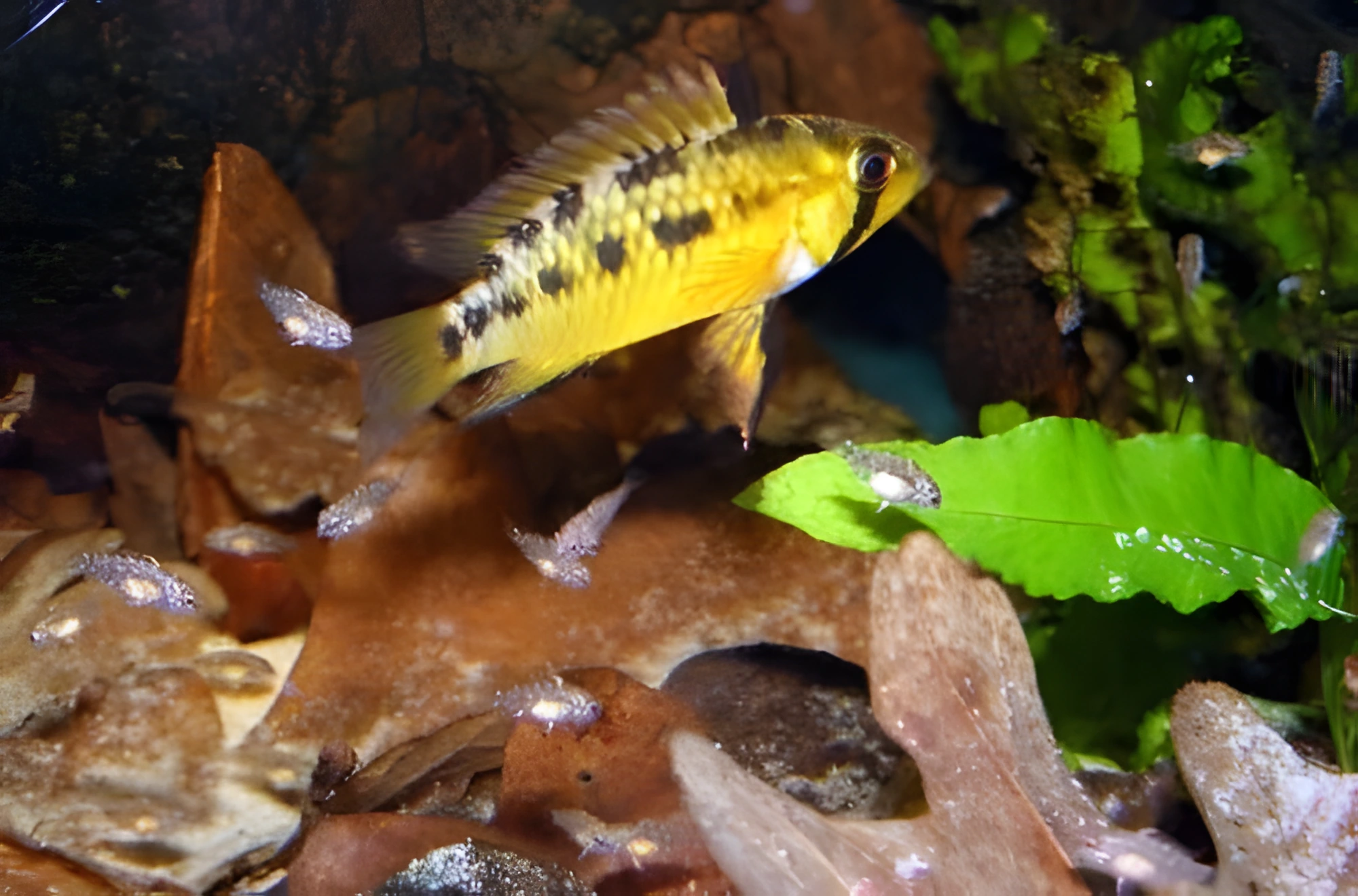
Adults reach a length of approximately 4–5 cm. Males are usually larger than females and have more intense coloration. Depending on the chosen selective breeding form, their body can be predominantly yellow or red, while the pattern remains constant: it consists of several dark parallel lines and one dark diagonal stripe passing through the eye.
Habitat
Its natural habitat is in South America, in present-day Colombia. These fish are found within the limited confines of the upper Meta River basin, including the Metica and Guayuriba rivers and their tributaries. Originally, this region was covered by tropical forests with extensive flooded and marshy areas along the riverbeds. However, in recent decades, the landscape has significantly changed due to active agricultural development: tropical forests have been cleared, and swamps drained to create fields and pastures.
Behavior and Compatibility
These fish are peaceful and friendly, especially if kept in a group consisting of one male and several females. In limited aquarium space and with multiple males during the breeding season, territorial conflicts may arise. Apistogramma macmasteri coexist well with other calm fish species of similar size. It is recommended to avoid cohabitation with other Apistogramma species to prevent interspecies hybridization.
Care and Maintenance
Most Apistogramma macmasteri offered for sale are raised on commercial fish farms; wild specimens are extremely rare. This means their adaptation to aquarium conditions is quite easy. These fish will feel comfortable in an aquarium of 40 liters or more, equipped with a sand substrate, live or artificial plants, and several shelters, such as driftwood or other decorative elements. Lighting should be kept subdued, which can be achieved, among other things, by using floating plants on the water surface. Water parameters should correspond to slightly acidic pH and have low carbonate hardness. Sometimes, to recreate the brownish tint of water characteristic of their natural habitat, tannin essences are used, or tree leaves with a high tannin content, such as Indian almond, oak, or European beech, are added. Leaves are first dried and then soaked until they begin to sink, and only then placed in the aquarium. Tannins are gradually released into the water as the leaves decompose, giving it the desired color. Leaves should be replaced every few weeks. Aquarium care includes regular cleaning of the substrate from organic debris and weekly partial water changes (10–15% of the total volume) with fresh water.
Diet
Being carnivorous, in their natural environment, they feed on small benthic invertebrates, including crustaceans and insect larvae. In aquarium conditions, it is recommended to include live or frozen foods in their diet, such as bloodworms, daphnia, and brine shrimp. As supplementary or alternative feeding, sinking commercial foods (flakes, granules) enriched with protein can be used.
Breeding and Reproduction
Given optimal conditions, including suitable water parameters and temperature, as well as a balanced diet, the probability of successful fry appearance is very high. During spawning, the female chooses a shelter and lays up to 120 eggs. Her maternal instincts are fully manifested: she remains to guard the clutch and then will protect the newly hatched fry, which stay close to her. The male also participates in protecting the offspring, but sometimes his behavior becomes excessively aggressive, and then he has to be temporarily moved to a separate aquarium. If several females are kept in the aquarium, all of them may produce offspring. In such a case, it is important to ensure that the number of shelters corresponds to the number of females and that they are located in different parts of the aquarium.
Diseases
The main cause of most diseases in Leaf Fish is unsuitable keeping conditions and poor-quality nutrition. If initial symptoms are observed, it is first necessary to check water parameters and the concentration of dangerous substances such as ammonia, nitrites, and nitrates. If the indicators deviate from the norm, they should be brought back into order, and only then should treatment begin. More detailed information on symptoms and treatment methods can be found in the "Aquarium Fish Diseases" section.
How to choose
When purchasing, choose active individuals with clean fins and no visible body damage. Avoid fish with sunken bellies, signs of emaciation, or unnatural behavior, such as constantly sitting in a corner when attempts are made to interact. Healthy Apistogrammas should have clear eyes and a distinct, vibrant coloration corresponding to their species standard.
- Inspect the store aquarium for any deceased individuals in the same tank.
- Ask the seller what the fish are fed to ensure a smooth transition to your diet.
- Prioritize individuals that show curiosity and react to movement near the glass.
Frequently asked questions
The essentials: size, tank volume, water parameters and care
How big does Apistogramma macmasteri get?
An adult reaches 5 cm in length. Plan the tank around the maximum size: the fish quickly outgrows a cramped setup.
What size aquarium does Apistogramma macmasteri need?
The minimum recommended volume is 40 L. A smaller tank speeds up nitrate build-up and raises stress levels.
What water parameters does Apistogramma macmasteri need?
Temperature 24–28 °C, pH 5–7, hardness 1–5 dGH. Stability matters more than exact values: sudden swings are harder on the fish than a small deviation from the ideal.
How long does Apistogramma macmasteri live?
Around 4 years when kept properly. Lifespan depends directly on tank volume, water quality and a varied diet.
Is Apistogramma macmasteri aggressive?
Temperament: semi-peaceful (including aggression during spawning / intraspecific conflicts). Keep this in mind when choosing tank mates.
How many Apistogramma macmasteri should be kept together?
Recommended setup: harem (1 male and several females). Ignoring this is a common cause of stress and disease.
What does Apistogramma macmasteri eat?
Diet type: meat / protein (live, frozen, fresh). Feed small portions that are finished within a couple of minutes — overfeeding does more harm than underfeeding.
What is the scientific name of Apistogramma macmasteri?
The scientific name of the species is Apistogramma macmasteri, family Cichlids (Cichlidae).