Temperature23 – 27 °C
Natural range
- Sierra Leone area
- Guinea area
- Liberia area
- Upper Guinea forests area
CichlidsConservation status: Least concern LC
Other scientific names: Haplochromis thomasi, Hemichromis thomasi, Paratilapia thomasi, Pelmatochromis thomasi
Anomalochromis thomasi, known scientifically as Anomalochromis thomasi, belongs to the family Cichlidae. These fish are characterized by their undemanding nature and attractive, vibrant coloration. They also exhibit good compatibility with many other freshwater inhabitants. The combination of these qualities makes them an excellent choice, especially for those just starting their journey in aquaristics.
- Required aquarium volume
- 80 L
- Size in aquarium
- 8 cm
- Temperature
- 23 – 27 °C
- Temperament
- Peaceful (regular)
Parameters
Water pHSlightly acidic (5.5) – Neutral (7.5)
Water dHVery soft (1) – Hard (15)
Water salinityno salt (freshwater)
Size in aquarium8 cm
Lifespan5 years
TemperamentPeaceful (regular)
Toward small fishnot a predator
Required aquarium volume80 L
Lightingmoderate (regular)
Substraterocky (rock formations, boulders, etc.)
Water flowweak or moderate
FeedingSmall / appropriate size / pieces
CareBoth solitary and in group (flexible)
Description
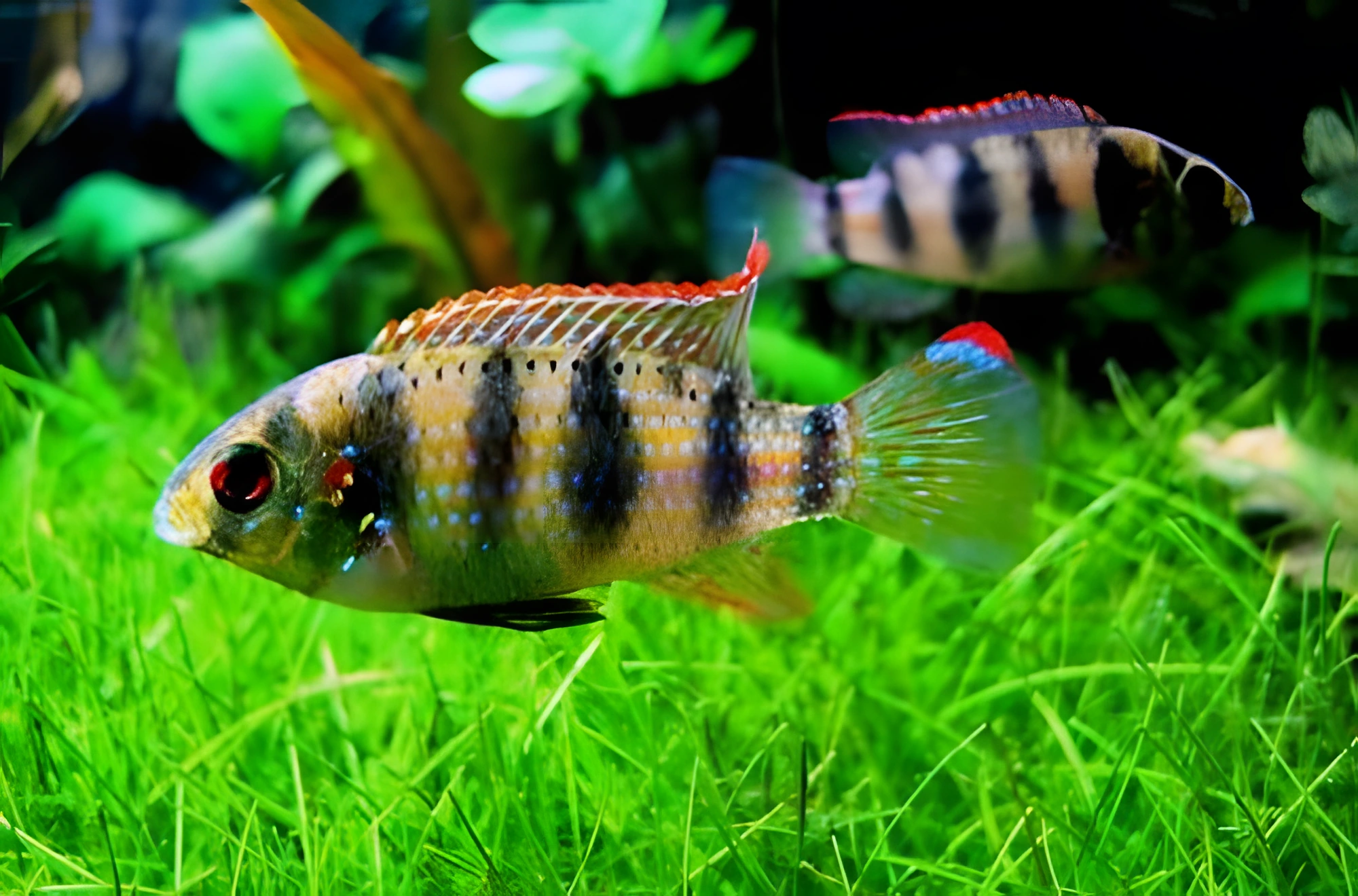
Adults of this fish reach a length of up to 7–8 cm. Males are generally slightly larger and have brighter coloration. The main body color is gray, adorned with rows of vertical black stripes. Small bluish speckles are scattered across the entire body, and the fins and tail are edged in red. It is important to note that young fish, which are most often found for sale, appear quite dull, and their true, full coloration only develops upon reaching adulthood.
Habitat
The natural habitat of this species extends across the equatorial part of Africa, covering the territory of modern-day Sierra Leone, Guinea, and Liberia. Anomalochromis inhabit numerous streams and small rivers that flow under the dense canopy of tropical forests. These bodies of water are characterized by a high content of various plant debris, such as leaves, fruits, and snags, which leads to the water being saturated with tannins and gives it a typical tea-like hue.
Behavior and Compatibility
These fish are peaceful and rather shy by nature, but they become territorial during spawning. Nevertheless, even at this time, they usually pose no danger to other species. Anomalochromis thomasi can be kept in a group, as well as combined with other non-aggressive African fish species of comparable size.
Care and Maintenance
For a small group of fish, the optimal aquarium size starts from 80 liters. For decor, sandy or fine-grained gravel is recommended for the bottom, supplemented with several flat stones that can serve as spawning sites. It is also necessary to provide plenty of shelters — these can be snags or various decorative elements. Even ceramic pots laid on their side or hollow PVC tubes will work for this purpose. The choice of specific decor is determined by the aquarium owner's preferences. The presence of live plants is not a mandatory condition. A key factor for the successful keeping of Anomalochromis thomasi is maintaining stable water parameters that meet their pH and dGH requirements. An effective filtration system in the aquarium, as well as regular weekly water changes of 15–20% of the volume with fresh water, will help ensure acceptable water quality. To bring water conditions closer to natural ones, Indian almond leaves can be used. As they decompose, they release tannins, giving the water a characteristic brownish tint. Alternatively, oak leaves can be used; they should be dried beforehand and then soaked so that they sink and do not float to the surface.
Diet
These fish are not particularly demanding regarding their diet. They readily eat all popular types of food. For example, their daily diet can consist of a combination of dry flakes or pellets with live or frozen bloodworms and Artemia. Feeding exclusively dry foods is also permissible, but in this case, it is important to choose high-quality products from reputable manufacturers.
Breeding and Reproduction
Breeding Anomalochromis thomasi usually does not present great difficulties. Unlike many other African species, they are able to successfully reproduce within a fairly wide range of pH and dGH values, allowing fry to appear even in a community tank. This species is monogamous: a male and female form a strong pair from among their kin, which lasts for a long time. Pair formation is most likely if the fish grew up together from a young age. With the onset of the breeding period, the pair occupies a specific area on the aquarium bottom, creating a temporary territory that they actively defend. A flat stone or a wide plant leaf located close to the bottom is usually chosen for spawning. The fish carefully clean the chosen surface of organic deposits. The female lays up to 500 eggs. The incubation period lasts approximately 48 hours. During this time, the female remains constantly near the clutch, while the male patrols the borders of their territory. In addition, they manage to dig several small pits in the substrate, where the fry will alternately stay after hatching. Parental care continues for no more than a month, after which the fry become completely independent.
Diseases
The main cause of most diseases in Leaf Fish is unsuitable keeping conditions and poor-quality nutrition. If initial symptoms are observed, it is first necessary to check water parameters and the concentration of dangerous substances such as ammonia, nitrites, and nitrates. If the indicators deviate from the norm, they should be brought back into order, and only then should treatment begin. More detailed information on symptoms and treatment methods can be found in the "Aquarium Fish Diseases" section.
How to choose
When choosing individuals, pay attention to their activity and the absence of visible damage. Healthy fish should show curiosity, have clean fins without signs of erosion, intact scales, and clear eyes. Avoid specimens with sunken bellies, signs of emaciation, or unnatural behavior, such as a constant desire to hide in a corner in the absence of other fish.
- it is preferable to acquire young fish, as they adapt more easily to new conditions and form stable pairs more quickly
- it is recommended to inspect all fish in the seller's aquarium: the presence of sick or dead individuals nearby may indicate general problems with water quality or infections
- check the brightness of the coloration: even under stressful conditions in the store, healthy Anomalochromis should show characteristic sparkles on their scales and the basic stripe pattern
Frequently asked questions
The essentials: size, tank volume, water parameters and care
How big does Anomalochromis thomasi get?
An adult reaches 8 cm in length. Plan the tank around the maximum size: the fish quickly outgrows a cramped setup.
What size aquarium does Anomalochromis thomasi need?
The minimum recommended volume is 80 L. A smaller tank speeds up nitrate build-up and raises stress levels.
What water parameters does Anomalochromis thomasi need?
Temperature 23–27 °C, pH 5.5–7.5, hardness 1–15 dGH. Stability matters more than exact values: sudden swings are harder on the fish than a small deviation from the ideal.
How long does Anomalochromis thomasi live?
Around 5 years when kept properly. Lifespan depends directly on tank volume, water quality and a varied diet.
Is Anomalochromis thomasi aggressive?
Temperament: peaceful (regular). Keep this in mind when choosing tank mates.
How many Anomalochromis thomasi should be kept together?
Recommended setup: both solitary and in group (flexible). Ignoring this is a common cause of stress and disease.
What does Anomalochromis thomasi eat?
Diet type: small / appropriate size / pieces. Feed small portions that are finished within a couple of minutes — overfeeding does more harm than underfeeding.
What is the scientific name of Anomalochromis thomasi?
The scientific name of the species is Anomalochromis thomasi, family Cichlids (Cichlidae). It also appears in the literature as: Haplochromis thomasi, Hemichromis thomasi, Paratilapia thomasi.