Temperature24 – 32 °C
Natural range
- Jalisco area
- Mexico area
Livebearers
Ameca splendens belongs to the family Goodeidae. This fish is active and mobile, yet its temperament can be described as feisty. Such a character narrows the choice of possible tank mates, but observing it is very interesting, as it certainly cannot be called boring. Thanks to its unpretentiousness in feeding and relative ease of care, Ameca splendens can be confidently recommended to beginner aquarists.
- Required aquarium volume
- 80 L
- Size in aquarium
- 9 cm
- Temperature
- 24 – 32 °C
- Temperament
- Peaceful, but may bite fins
Parameters
Water pHNeutral (7) – Slightly alkaline (8)
Water dHMedium hardness (9) – Very hard (19)
Water salinityno salt (freshwater)
Size in aquarium9 cm
Lifespan4 years
TemperamentPeaceful, but may bite fins
Toward small fishnot a predator
Required aquarium volume80 L
Lightingmoderate (regular)
Substrateany, but dark
Water flowmoderate
FeedingAny (universal)
CareGroup (8–10 individuals)
Description
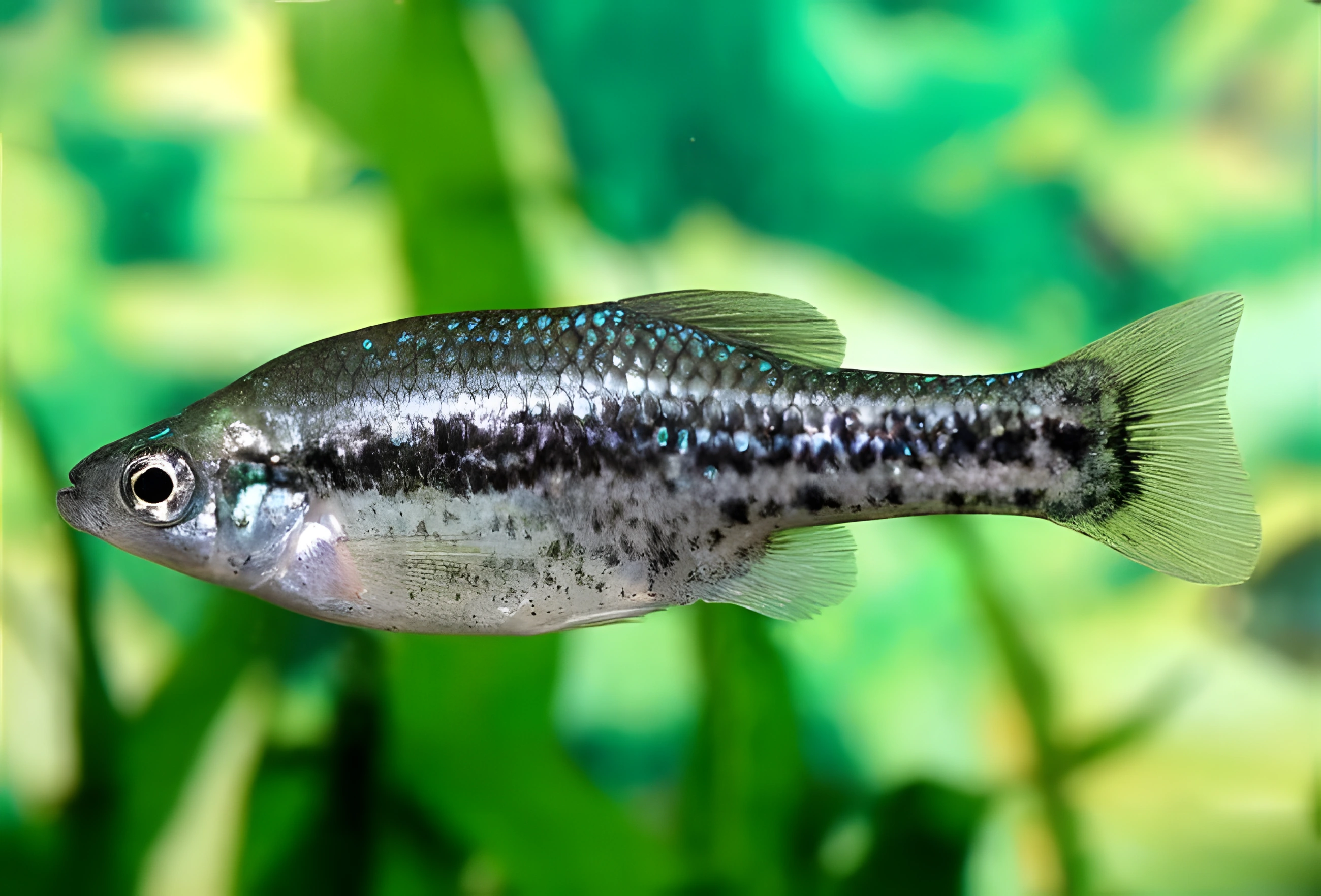
Males are somewhat smaller and have a more slender build. Their coloration is dark gray, adorned with numerous irregularly shaped black spots concentrated mainly along the lateral line. The fins are also dark but have a bright yellow edging along the margins. Females, on the other hand, have a larger and rounder body; they are less graceful. Their coloration is lighter, while the pattern of dark spots is similar to that of males.
Habitat
Originally, this fish inhabits Central America; wild populations are found in some mountain rivers, such as the Rio Ameca and its tributaries, flowing in the vicinity of the city of Ameca, located near Guadalajara, the capital of the Mexican state of Jalisco. In 1996, Ameca splendens was declared extinct in the wild. Nevertheless, recent studies have shown that these fish continue to live in their natural habitat. Certain requirements and conditions are important for their successful keeping.
Behavior and Compatibility
This fish exhibits activity, and sometimes aggression, especially noticeable among males, but intraspecific skirmishes rarely lead to serious injuries. Over time, an alpha male usually emerges in a group, distinguished by brighter and more intense coloration. During feeding, the fish actively compete, and when kept with slow-moving species, the latter may not get their share of food. The excessive activity of Ameca splendens is also a factor limiting the choice of tank mates. Therefore, it is recommended to select fish of similar temperament and size or to keep them in a species-only tank.
Care and Maintenance
Ameca, being native to flowing mountain waters, has high demands for aquarium water quality. The main condition is to maintain minimal pollution levels. At the same time, water parameters such as GH and pH take a back seat, as the fish adapt well to a wide range of these values. Since a group of these fish produces a significant amount of waste, it is necessary to perform weekly water changes of 30–40% of the volume and install a powerful filter to maintain an acceptable level of cleanliness. The substrate should also be regularly cleaned of organic residues, and algae should be removed from the aquarium walls. Oxygen saturation of the water is also important; for this purpose, an aeration system with several air stones is used. The bubbles should be as fine as possible but still reach the surface without completely dissolving in the water. Minimally necessary equipment also includes a heater and a lighting system. In aquarium design, preference is given to dense thickets of plants, while it is important to leave open spaces for swimming. A dark substrate enhances the fish's best colors. Other decorative elements are chosen according to the aquarist's taste.
Diet
This species is omnivorous. Ameca splendens readily accepts various types of dry foods, including flakes and pellets. It is very important to provide plant-based supplements in their diet; these can be specialized foods, spirulina, fresh spinach, or dried nori seaweed. Feeding is recommended two or three times a day, offering an amount of food that the fish can consume within 5 minutes. Aqvium flake food for aquarium fish, which has received high ratings on Ozon (4.9), will be an excellent choice. This product, suitable for most aquarium fish, is made from raw materials that comply with new European Union standards (EU 2018/848) and is enriched with vitamins A, C, D3, E, as well as Omega 3-6. It can be purchased on Ozon.
Breeding and Reproduction
Breeding these fish at home occurs without particular difficulties and does not require separate tanks or the creation of specific conditions. Spawning can happen at any time of the year. The mating period is initiated by the female, who begins to swim diagonally next to the male, making trembling movements. When the male is ready, mating occurs. Pregnancy lasts from 55 to 60 days, during which the female's abdomen significantly increases. The fry are born fully formed and are immediately ready to accept regular food, previously finely ground. They can be kept with their parents, as cannibalism is not observed among them. A unique feature of this species, distinguishing it from other livebearing fish, is the formation of internal structures in the female during pregnancy, similar to the mammalian placenta. Through these structures, the fry are nourished, allowing them to remain in the mother's womb significantly longer and emerge fully self-sufficient. In the first days after birth, the fry show small outgrowths — remnants of that very “placenta-umbilical cord.”
Diseases
Amecas have high resistance to diseases. In a favorable environment, health problems usually do not arise. Difficulties only appear in neglected aquariums or when in contact with already sick individuals. More detailed information on symptoms and treatment methods can be found in the "Aquarium Fish Diseases" section.
How to choose
When purchasing, choose active and lively individuals, avoiding fish with signs of lethargy or scale damage. Healthy Amecas should show curiosity and react quickly to external stimuli. Carefully inspect the fins: they should be intact, without signs of rot or white film. Since the species has a feisty character, fish in the store may exhibit intraspecific aggression, which is normal; however, avoid individuals with obvious torn wounds or deep scratches on the body. It is recommended to acquire a group of several individuals to reduce stress levels and distribute aggression within the school. Before purchasing, make sure there are no dead individuals in the aquarium with the fish, as this may indicate poor water quality or the presence of hidden infections.
Frequently asked questions
The essentials: size, tank volume, water parameters and care
How big does Ameca splendens get?
An adult reaches 9 cm in length. Plan the tank around the maximum size: the fish quickly outgrows a cramped setup.
What size aquarium does Ameca splendens need?
The minimum recommended volume is 80 L. A smaller tank speeds up nitrate build-up and raises stress levels.
What water parameters does Ameca splendens need?
Temperature 24–32 °C, pH 7–8, hardness 9–19 dGH. Stability matters more than exact values: sudden swings are harder on the fish than a small deviation from the ideal.
How long does Ameca splendens live?
Around 4 years when kept properly. Lifespan depends directly on tank volume, water quality and a varied diet.
Is Ameca splendens aggressive?
Temperament: peaceful, but may bite fins. Keep this in mind when choosing tank mates.
How many Ameca splendens should be kept together?
Recommended setup: group (8–10 individuals). Ignoring this is a common cause of stress and disease.
What does Ameca splendens eat?
Diet type: any (universal). Feed small portions that are finished within a couple of minutes — overfeeding does more harm than underfeeding.
What is the scientific name of Ameca splendens?
The scientific name of the species is Ameca splendens, family Goodeidae.