Temperature21 – 35 °C
Natural range
- Florida area
- Texas area
Killifish
Other scientific names: Adinia multifasciatus
Adinia xenica, or the Diamond Killifish, belongs to the family Fundulidae. Despite its outstanding hardiness and high endurance, this species is not suitable for a community tank, as its habitat is exclusively brackish water. Specific water requirements combined with a rather modest coloration make it not very popular among aquarists. Although the fish is practically absent from the European market, it can be found with qualified breeders.
- Required aquarium volume
- 80 L
- Size in aquarium
- 5 cm
- Temperature
- 21 – 35 °C
- Temperament
- Territorial (often aggressive)
Parameters
Water pHNeutral (7.5) – Alkaline (9)
Water dHMedium hardness (10) – Very hard (31)
Water salinityvery low (up to ~3 g/L)
Size in aquarium5 cm
Lifespan3 years
TemperamentTerritorial (often aggressive)
Toward small fishnot a predator
Required aquarium volume80 L
Lightingmoderate (regular)
Substrateany (no restrictions)
Water flowweak
FeedingAny (universal)
CareSolitary
Description
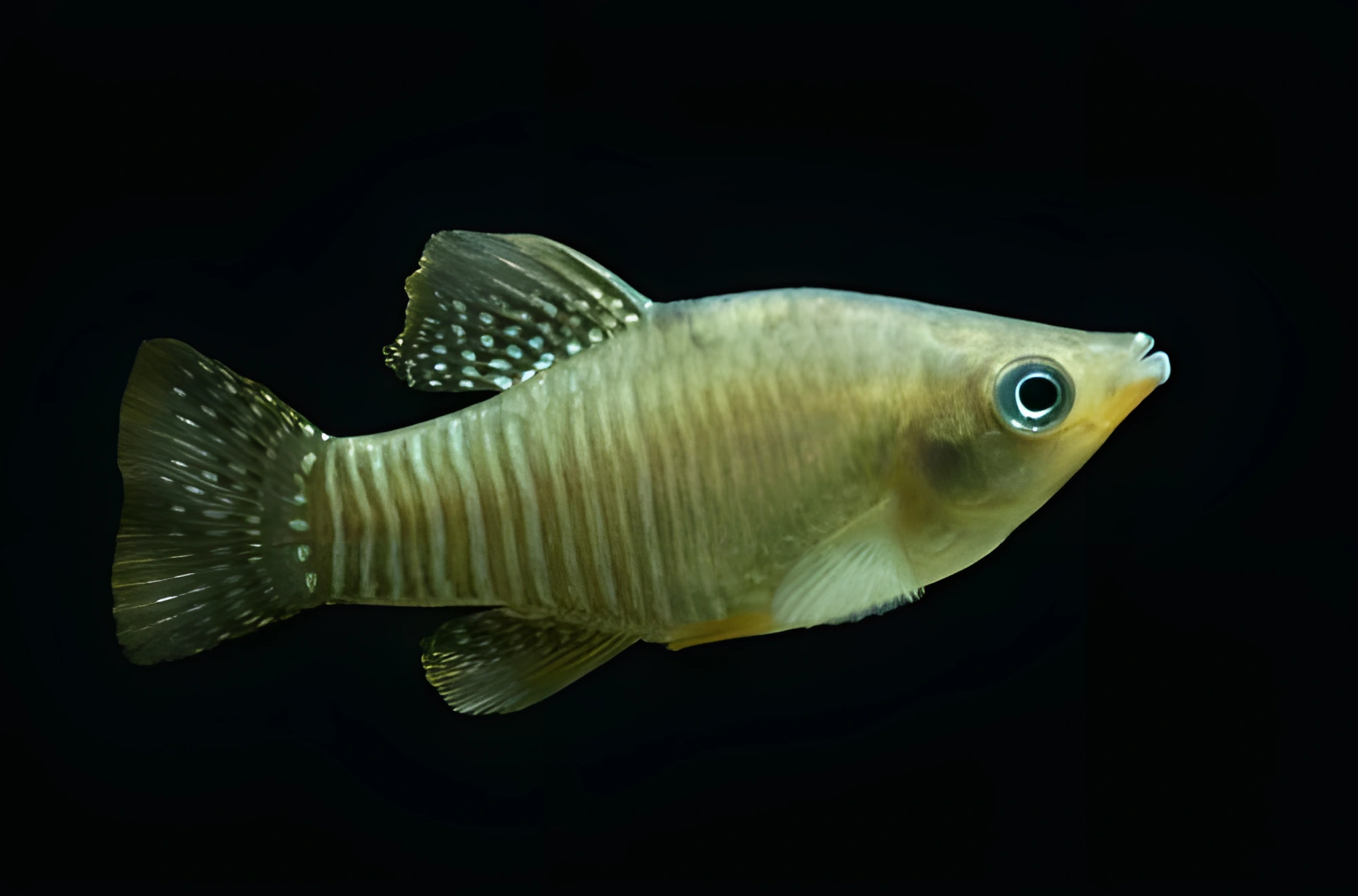
Adult males reach 5 cm in length, while females are somewhat smaller. The fish has a high body shape and a pointed head. If you mentally remove the fins, the fish's shape from the side resembles a horizontally elongated rhombus. The coloration is light, sand-colored, adorned with rows of contrasting vertical stripes. The fins remain transparent, but numerous blue speckles are visible at their base.
Habitat
The first specimens of these fish, which served as the basis for subsequent scientific description, were discovered near the former large port of Indianola, located on the coast of the Gulf of Mexico in modern Texas. Today, this city is considered a ghost town, as it was destroyed by a series of hurricanes in the late 19th century. The natural habitat of the species covers almost the entire northern coast of the Gulf, extending from the tip of Florida to Texas. The Diamond Killifish prefers shallow areas, usually not exceeding 30 cm in depth. Such biotopes include coastal lagoons, salt marshes, isolated pools, and first-order channels, most often where submerged vegetation and filamentous algae prevail.
Behavior and Compatibility
Due to specific keeping conditions, such as brackish water, the Diamond Killifish is not compatible with most other fish species. Intraspecific relationships are characterized by a strict hierarchy among males: there is always one dominant male, and the others are attacked if they have nowhere to hide. The recommended ratio for keeping a group is 1 male to 2–3 females.
Care and Maintenance
When keeping Diamond Killifish, key attention should be paid to the aquarium setup. A 60–80 liter tank will be sufficient for a small group of individuals. The substrate can be any, or it can be omitted, but in this case, the setup will look incomplete. Essential elements are shelters created from snags, intertwined tree roots, and stone piles forming grottoes and caves. Females and subdominant males can hide in them as needed. Preferred plants include hornworts, mosses, and ferns. Aquarium equipment should include a heater, aerator, lighting system, and a simple filter with a low flow rate, as the fish do not like strong currents. An important condition for successful keeping is brackish water, with the optimal concentration of marine salt ranging from 3 to 10 grams per 1 liter. Aquarium maintenance involves weekly partial water changes with fresh water and regular cleaning of the substrate from organic waste.
Diet
In their natural habitat, these fish eat almost anything they can find. Their diet includes blue-green and diatom algae, plant particles, rotifers, nematodes, copepods, as well as insect larvae and more. In aquarium conditions, they readily accept various dry, frozen, and live foods. It is important to supplement their diet with plant additives, such as spirulina flakes or similar products. It should be noted that young individuals require more protein food, so live foods are essential for them. Feeding is done 2–3 times a day, in portions that the fish eat within 5 minutes. All food residues must be removed promptly.
Breeding and Reproduction
Successful breeding of these fish is relatively straightforward, provided the aquarium is properly organized. Since the parents can eat both eggs and their offspring, it is recommended to spawn them in a separate, specially prepared tank. Otherwise, the fry may simply not survive to adulthood. It is important that the water parameters and setup of this breeding tank fully match the conditions of the main aquarium. When kept in a harem (with several females per male), the breeding season can begin between March and September. Its onset is easy to determine visually: it is noted that the male acquires a brighter coloration and begins to actively pursue females, whose abdomens noticeably round out during this period. First, the females are moved to the breeding tank, given time to settle in, and after a few days, the male is introduced. Groups of eggs, usually 30 at a time, are attached to plants. After the spawning process is complete, the parents should be returned to the main aquarium. The incubation period lasts from 9 to 11 days, after which fully formed fry emerge, capable of feeding on Artemia nauplii, finely crushed dry flakes, microworms, and similar foods.
Diseases
No specific diseases exclusively characteristic of this species have been identified. The main health problems arise from an imbalance in water salinity. Since the species is adapted to brackish conditions, prolonged keeping in fresh water leads to salt depletion in the body, weakening of the immune system, and susceptibility to infections. Prevention involves maintaining the necessary concentration of marine salt (3–10 g/L) and ensuring stable environmental parameters.
How to choose
When purchasing, choose active fish with clean fins and no visible skin damage. Healthy individuals should have clear coloration, without cloudy spots or film. It is recommended to pay attention to their behavior: fish should show curiosity and actively respond to external stimuli. Avoid individuals that stay at the water surface, appear apathetic, or show signs of emaciation, as this may indicate improper keeping conditions at the store or hidden diseases.
Frequently asked questions
The essentials: size, tank volume, water parameters and care
How big does Diamond Killifish get?
An adult reaches 5 cm in length. Plan the tank around the maximum size: the fish quickly outgrows a cramped setup.
What size aquarium does Diamond Killifish need?
The minimum recommended volume is 80 L. A smaller tank speeds up nitrate build-up and raises stress levels.
What water parameters does Diamond Killifish need?
Temperature 21–35 °C, pH 7.5–9, hardness 10–31 dGH. Stability matters more than exact values: sudden swings are harder on the fish than a small deviation from the ideal.
How long does Diamond Killifish live?
Around 3 years when kept properly. Lifespan depends directly on tank volume, water quality and a varied diet.
Is Diamond Killifish aggressive?
Temperament: territorial (often aggressive). Keep this in mind when choosing tank mates.
How many Diamond Killifish should be kept together?
Recommended setup: solitary. Ignoring this is a common cause of stress and disease.
What does Diamond Killifish eat?
Diet type: any (universal). Feed small portions that are finished within a couple of minutes — overfeeding does more harm than underfeeding.
What is the scientific name of Diamond Killifish?
The scientific name of the species is Adinia xenica, family Fundulidae. It also appears in the literature as: Adinia multifasciatus.