Temperature24 – 27 °C
Natural range
- Amazon River Basin
- Orinoco River Basin
- Brazil area
- Peru area
CichlidsConservation status: Least concern LC
Other scientific names: Acara tetramerus, Acaronia trimaculata, Aequidens stollei, Chromys uniocellata
Aequidens tetramerus, known scientifically as Aequidens tetramerus, belongs to the famous family Cichlidae. This is a rather large fish, attracting attention with its bright coloration. Many aquarists appreciate it for its comparative ease of keeping and successful breeding. Thanks to its compatibility with many other species, it will be an excellent choice for beginners in the underwater world.
- Required aquarium volume
- 250 L
- Size in aquarium
- 16 cm
- Temperature
- 24 – 27 °C
- Temperament
- Semi-peaceful (including aggression during spawning / intraspecific conflicts)
Parameters
Water pHAcidic (4.5) – Neutral (7.5)
Water dHVery soft (1) – Very hard (21)
Water salinityno salt (freshwater)
Size in aquarium16 cm
Lifespan7 years
TemperamentSemi-peaceful (including aggression during spawning / intraspecific conflicts)
Toward small fishnot a predator
Required aquarium volume250 L
Lightingdimmed
Substratesandy (regular, light)
Water flowweak
FeedingAny (universal)
CarePair (male/female)
Description
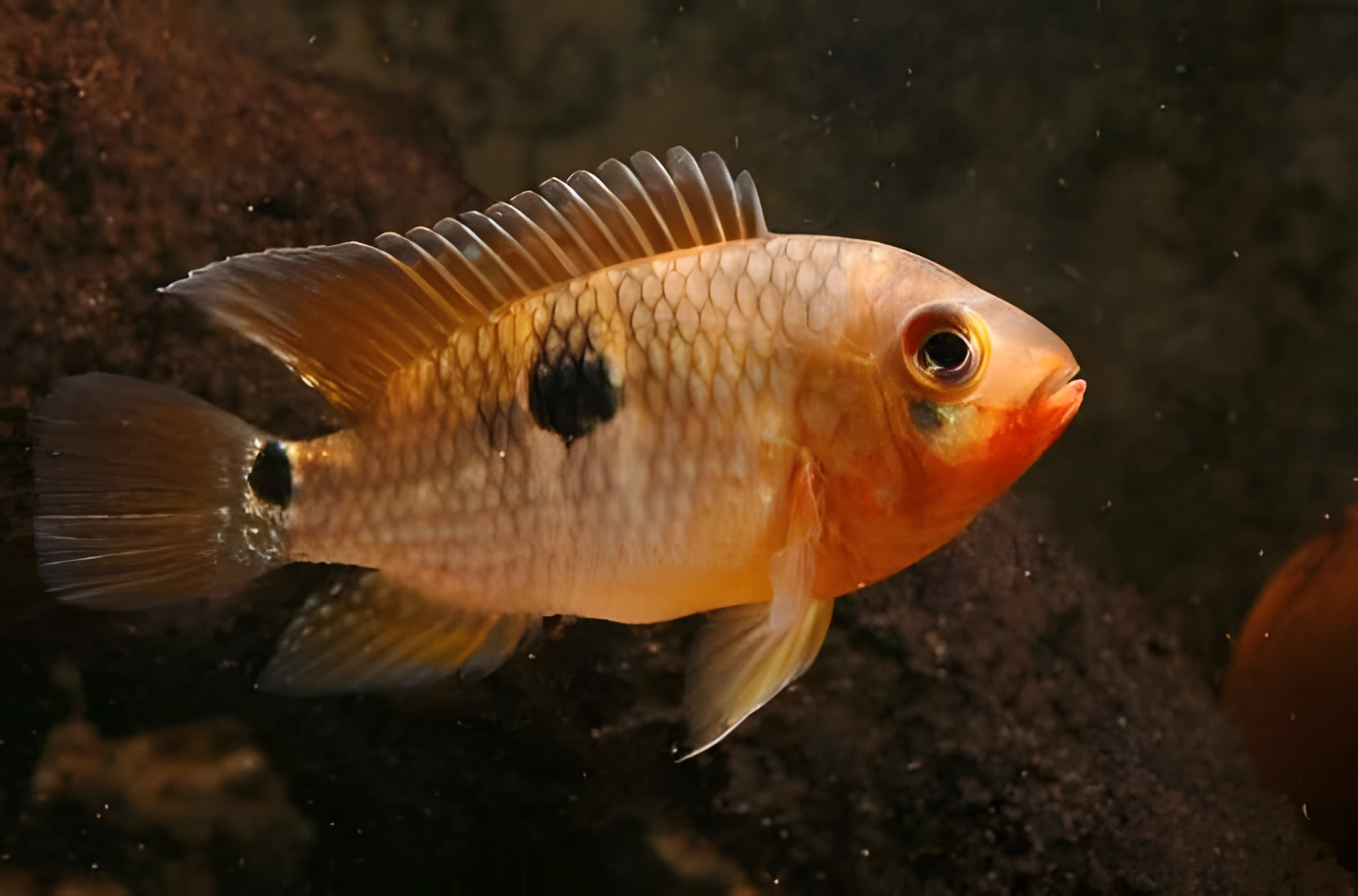
Adults of this fish can grow up to 16 cm in length. Their body is large and massive, yet slightly compressed laterally. The dorsal fin occupies most of the upper edge of the body, extending virtually from the head to the very tail. Sexual dimorphism in Aequidens tetramerus is rather weak; differences between males and females are minimal. The coloration of representatives of this species can vary from rich red to delicate blue, which is often associated with their specific region of origin. A distinctive feature of the body pattern is two noticeable spots: one is located in the central part of the body, and the second is at the base of the tail. Between them, a barely discernible black stripe can be seen running along the lateral line.
Habitat
This species originates from South America, where its natural habitats are widely spread across the vast basins of the Amazon and Orinoco rivers, covering the territories of modern Brazil, Peru, Colombia, and Venezuela. Aequidens tetramerus feels equally well in both clear and more turbid waters. Preference is given to shady areas of rivers rich in submerged snags, while the banks are often adorned with aquatic plants, and the bottom is covered with a layer of fallen leaves.
Behavior and Compatibility
This species belongs to territorial fish. Males actively occupy and jealously guard their territory from any rivals, so in a small aquarium, it is recommended to keep only one male. They generally show benevolence towards females. Often, a male and female form a stable pair that can last for a long time. Given sufficient free space, these fish can successfully coexist with other species.
Care and Maintenance
For comfortable keeping of one or two fish, an aquarium of 250 L or more is recommended. The decor usually includes a soft substrate, several snags imitating tree roots and branches, optionally aquatic plants, and several large, smooth stones, which can later serve as an ideal spawning site. It is important to provide subdued lighting. Due to its wide geographical distribution, Aequidens tetramerus demonstrates an impressive ability to adapt to various conditions, especially regarding the hydrochemical composition of the water. It can successfully inhabit both very soft and acidic water, as well as hard water. Before acquiring these fish, it is highly desirable to clarify the conditions in which they were kept to reproduce them as accurately as possible in the home aquarium. The success of keeping will largely depend on maintaining a stable habitat, without sharp fluctuations in temperature, pH, dGH values, or the concentration of nitrogen cycle products — ammonia, nitrites, and nitrates. For this, the aquarium must be equipped with everything necessary, at least an effective filtration and heating system, and also regularly cleaned and have up to 50% of the water volume replaced weekly with fresh water.
Diet
This species is omnivorous. In a home aquarium, the fish will readily accept most common types of food intended for aquarium inhabitants. Their diet can easily include dry flakes and pellets, as well as frozen, live, or freeze-dried bloodworms, brine shrimp, and daphnia.
Breeding and Reproduction
Breeding this species is not particularly difficult if you already have an established male and female pair. Otherwise, inducing spawning will be much harder. The fish show high selectivity in choosing a partner, so simply introducing sexually mature individuals of different sexes does not guarantee successful pair formation. A proven approach is to acquire a group of young fish, consisting of at least six individuals, who will independently find suitable "life partners" as they mature. When the breeding season begins, the female lays several dozen eggs on a pre-selected flat surface, most often a flat stone, or in its absence, a thoroughly cleaned piece of driftwood. Throughout the incubation period, and also during the first weeks after the fry appear, both parents—the male and female—will vigilantly guard their offspring. Only when the juveniles reach a sufficient size do the parental instincts begin to wane.
Diseases
The main cause of diseases often lies in the keeping conditions: if they go beyond acceptable limits, immunity decreases, making the fish vulnerable to various infections inevitably present in the environment. At the first suspicion of illness, it is important first of all to check the water parameters and ensure there are no dangerous concentrations of nitrogen cycle products. Often, restoring normal, suitable conditions promotes recovery. However, in some cases, medication may be required. Detailed information on symptoms and treatment methods is presented in the "Aquarium Fish Diseases" section.
How to choose
When selecting individuals in a store, attention should be paid to their overall activity and the condition of their skin. Healthy fish should show curiosity, have no visible injuries, ulcers, white film, or fin erosion. It is important to avoid specimens with sunken bellies or apathetic behavior, as this may indicate hidden diseases or stress from improper keeping conditions.
Before purchasing, it is recommended to ask the seller about the water parameters the fish are accustomed to, to minimize the risk of shock during transfer. Since Aequidens rivulatus is a territorial species, it is advisable to purchase young individuals from the same group to ensure a natural pair forms in the future. In the store, fish may appear paler due to stress, but their coloration should be distinct, and their breathing even and calm.
Frequently asked questions
The essentials: size, tank volume, water parameters and care
How big does Aequidens tetramerus get?
An adult reaches 16 cm in length. Plan the tank around the maximum size: the fish quickly outgrows a cramped setup.
What size aquarium does Aequidens tetramerus need?
The minimum recommended volume is 250 L. A smaller tank speeds up nitrate build-up and raises stress levels.
What water parameters does Aequidens tetramerus need?
Temperature 24–27 °C, pH 4.5–7.5, hardness 1–21 dGH. Stability matters more than exact values: sudden swings are harder on the fish than a small deviation from the ideal.
How long does Aequidens tetramerus live?
Around 7 years when kept properly. Lifespan depends directly on tank volume, water quality and a varied diet.
Is Aequidens tetramerus aggressive?
Temperament: semi-peaceful (including aggression during spawning / intraspecific conflicts). Keep this in mind when choosing tank mates.
How many Aequidens tetramerus should be kept together?
Recommended setup: pair (male/female). Ignoring this is a common cause of stress and disease.
What does Aequidens tetramerus eat?
Diet type: any (universal). Feed small portions that are finished within a couple of minutes — overfeeding does more harm than underfeeding.
What is the scientific name of Aequidens tetramerus?
The scientific name of the species is Aequidens tetramerus, family Cichlids (Cichlidae). It also appears in the literature as: Acara tetramerus, Acaronia trimaculata, Aequidens stollei.