Temperature19 – 24 °C
Natural range
- Rio Jacuí basin
- Lagoa dos Patos area
- Porto Alegre area
- Rio Grande do Sul area
CichlidsConservation status: Least concern LC
Other scientific names: Acara portalegrensis, Aequidens portalegrensis, Cichlasoma portalegrensis, Cleithracara portalagrensis
Cichlasoma portalegrense, more commonly known as the Porto Alegre Acara, belongs to the Cichlidae family. This undemanding fish is distinguished by its peaceful nature, which sets it apart from other cichlids. Its excellent compatibility with various fish species makes it an ideal choice for aquarists, regardless of their experience.
- Required aquarium volume
- 100 L
- Size in aquarium
- 15 – 20 cm
- Temperature
- 19 – 24 °C
- Temperament
- Peaceful (regular)
Parameters
Water pHSlightly acidic (6) – Neutral (7)
Water dHVery soft (1) – Medium hardness (10)
Water salinityno salt (freshwater)
Size in aquarium15 – 20 cm
Lifespan6 years
TemperamentPeaceful (regular)
Toward small fishnot a predator
Required aquarium volume100 L
Lightingany
Substratesand or gravel + stones/boulders
Water flowweak or moderate
FeedingAny (universal)
CareMixed (solitary / pair / group)
Description
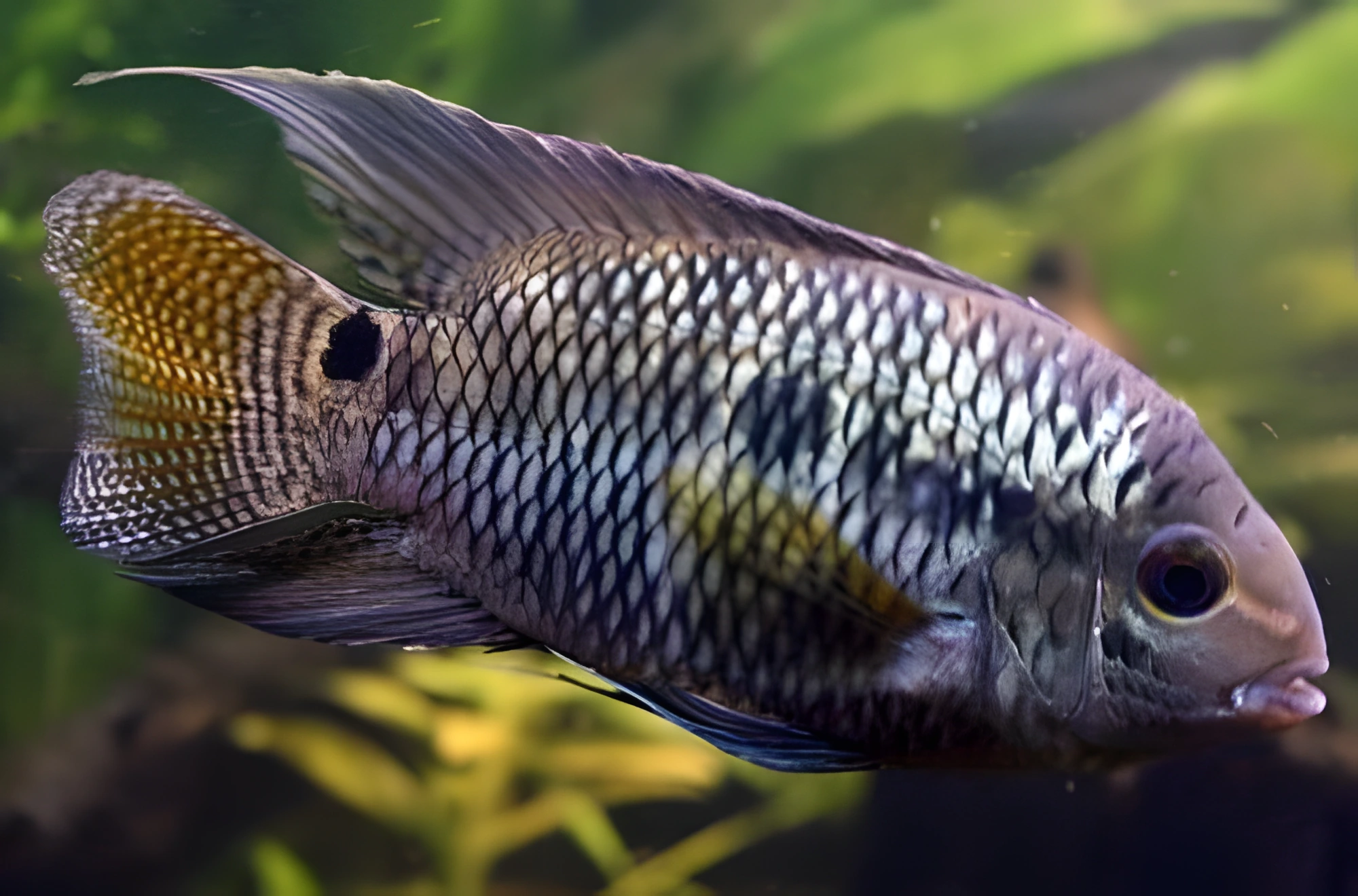
Adult Porto Alegre Acaras typically reach a length of 15 to 20 cm. Males can be distinguished by their larger size and pointed dorsal and anal fins. Their coloration is dark, with scales of a blue-green hue, each scale outlined in black. A characteristic feature is a black stripe running along the lateral line of the body, as well as prominent spots at the base of the caudal fin.
Habitat
The history of this fish began in Latin America, where it was first discovered in the southern regions of Brazil and Paraguay. Cichlasoma portalegrense owes its name to the city of Porto Alegre, near which it was scientifically described. Its natural habitat includes the Jacuí River basin, which features a delta with the aforementioned city, as well as the vast Patos Lagoon, the largest in Brazil. In these areas, it prefers calm, shallow parts of water bodies.
Behavior and Compatibility
This fish exhibits a peaceful and calm temperament, with the exception of short spawning periods, when males may show some intolerance towards conspecifics. They coexist well with many other non-aggressive South American cichlids and other species of comparable size. Porto Alegre Acaras feel comfortable both when kept alone, and in pairs or groups.
Care and Maintenance
For a comfortable life, a pair of Porto Alegre Acaras requires an aquarium of at least 100 liters. When decorating, sandy or gravel substrate is preferred, as well as the presence of various shelters, such as grottoes and caves. Although aquatic plants can be used, it is best to place them in separate pots to prevent them from being uprooted by the fish, which actively dig in the substrate. Maintaining high water quality with optimal pH and dGH parameters is a key aspect of care. Regular monitoring of nitrate levels and other nitrogenous compounds, as well as weekly water changes of 15–20% of the volume and cleaning the aquarium of organic debris, are essential. Installing a powerful filtration system also plays a significant role.
Diet
This species is carnivorous, but in a home aquarium, they readily accept a variety of foods. These can include dry flakes, as well as frozen and live foods such as bloodworms, earthworms, or brine shrimp. It is very important to include plant supplements in their diet; spirulina flakes, fresh cucumber pieces, lettuce or cabbage leaves, which can be conveniently secured to the bottom, are suitable.
Breeding and Reproduction
Breeding Porto Alegre Acaras is usually straightforward if the aquarium provides suitable spawning conditions. At the onset of the breeding season, the male first selects a suitable site on the aquarium bottom, which can be called the future spawning ground, and then invites the female there. The eggs are laid on a hard surface, typically a flat stone. If such a surface is not available, a pit dug in the substrate is used. However, in the latter case, some of the eggs will remain unfertilized as they will be trapped between substrate particles. Egg incubation takes approximately 4 days. The hatched fry are ovoid in shape and uniformly grayish-brown in color during their first days of life. As they grow and develop, their main colors begin to emerge. The parents care for their offspring for several weeks. If a threat arises, they signal, and the fry immediately hide in the spawning pit.
Diseases
The main cause of most diseases is unsuitable living conditions and poor-quality food. If you notice the first symptoms, you should immediately check the water parameters and ensure there are no high concentrations of dangerous substances (ammonia, nitrites, nitrates, etc.). The parameters must be brought back to normal, and only then can treatment measures begin. Detailed information on symptoms and treatment methods is provided in the "Aquarium Fish Diseases" section.
How to choose
When selecting individuals, attention should be paid to their activity and the cleanliness of their skin. Healthy fish should be curious, show no visible damage, ulcers, white film, or signs of emaciation. Avoid purchasing fish with sunken bellies or apathetic behavior, as this may indicate hidden diseases. In the store, it is important to assess the general living conditions: the cleanliness of the water in the aquarium and the absence of dead individuals near the chosen fish. Since the species is prone to territoriality, it is advisable to acquire young individuals to form a pair or keep them in a spacious aquarium to minimize stress during adaptation.
Frequently asked questions
The essentials: size, tank volume, water parameters and care
How big does Porto Alegre Acara get?
An adult reaches 15–20 cm in length. Plan the tank around the maximum size: the fish quickly outgrows a cramped setup.
What size aquarium does Porto Alegre Acara need?
The minimum recommended volume is 100 L. A smaller tank speeds up nitrate build-up and raises stress levels.
What water parameters does Porto Alegre Acara need?
Temperature 19–24 °C, pH 6–7, hardness 1–10 dGH. Stability matters more than exact values: sudden swings are harder on the fish than a small deviation from the ideal.
How long does Porto Alegre Acara live?
Around 6 years when kept properly. Lifespan depends directly on tank volume, water quality and a varied diet.
Is Porto Alegre Acara aggressive?
Temperament: peaceful (regular). Keep this in mind when choosing tank mates.
How many Porto Alegre Acara should be kept together?
Recommended setup: mixed (solitary / pair / group). Ignoring this is a common cause of stress and disease.
What does Porto Alegre Acara eat?
Diet type: any (universal). Feed small portions that are finished within a couple of minutes — overfeeding does more harm than underfeeding.
What is the scientific name of Porto Alegre Acara?
The scientific name of the species is Cichlasoma portalegrense, family Cichlidae. It also appears in the literature as: Acara portalegrensis, Aequidens portalegrensis, Cichlasoma portalegrensis.