Temperature21 – 32 °C
Natural range
- Gabon area
- Ogooué River Delta
KillifishConservation status: Least concern LC
Other scientific names: Aphyosemion calliurus, Aphyosemion hjerresensii, Aphyosemion polychromum, Aphysemion australe, Haplochilus calliurus, Panchax polychromus
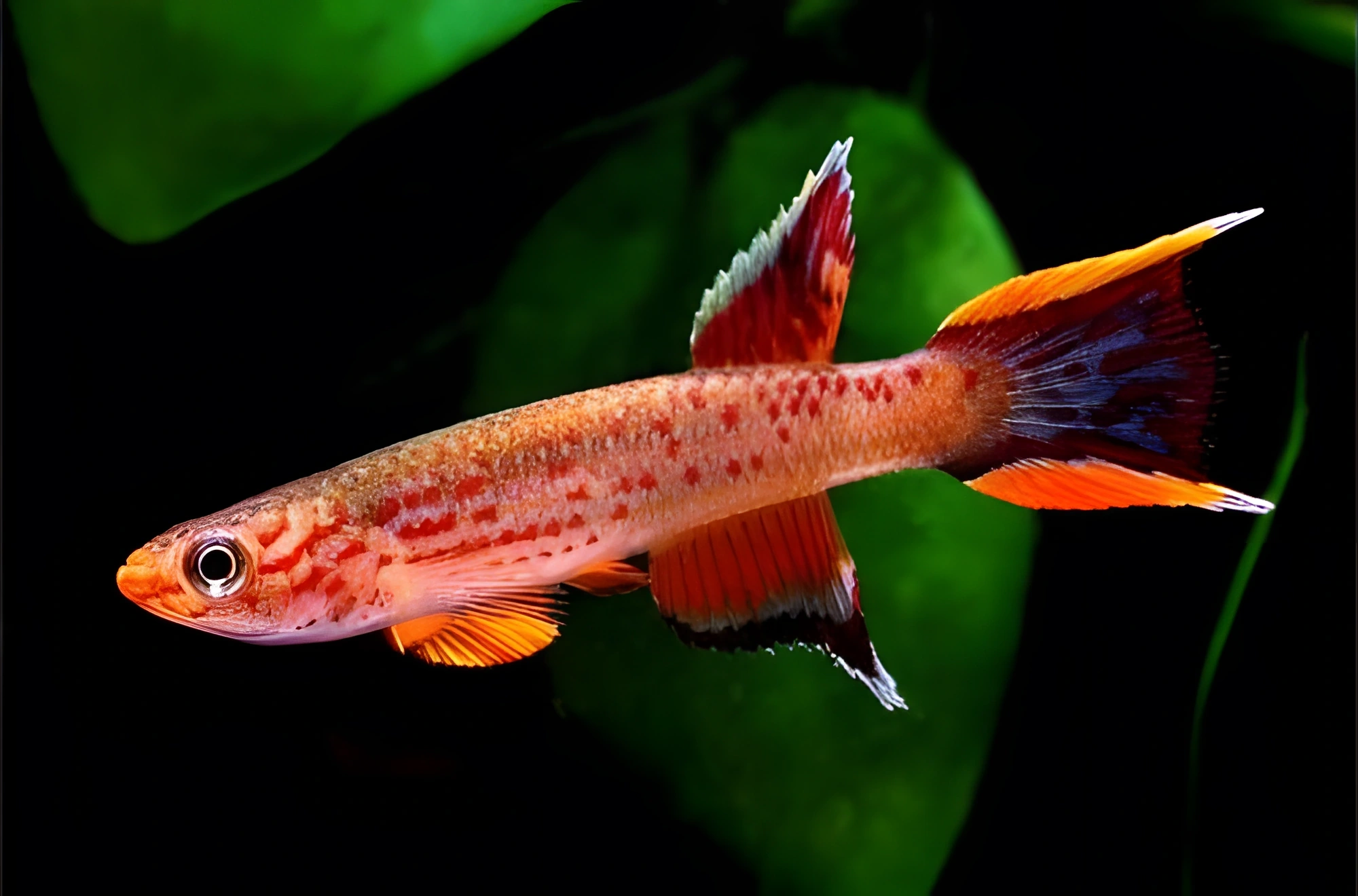
The Southern Aphyosemion, also known as the “Golden Pheasant” (scientific name Aphyosemion australe), is a representative of the family Nothobranchiidae. This fish was one of the first killifish to gain popularity in aquaristics due to its unpretentiousness, vibrant coloration, ease of breeding, and peaceful nature. The combination of these qualities makes it an excellent choice for beginner aquarists.
- Required aquarium volume
- 40 L
- Size in aquarium
- 6 cm
- Temperature
- 21 – 32 °C
- Temperament
- Peaceful (regular)
Parameters
Water pHSlightly acidic (5.5) – Neutral (7)
Water dHSoft (5) – Medium hardness (10)
Water salinityno salt (freshwater)
Size in aquarium6 cm
Lifespan3 years
TemperamentPeaceful (regular)
Toward small fishnot a predator
Required aquarium volume40 L
Lightingdimmed
Substratesandy (regular, light)
Water flowmoderate or strong
FeedingAny (universal)
CarePair (male/female)
Description
This fish has a narrow and shallow body, with elongated fins that are pointed at the ends and set quite far back. Several color morphs exist, with the most famous and sought-after being the orange variation, named “Golden Pheasant.” Males stand out with a spotted pattern of numerous bright speckles all over their bodies, while females usually appear noticeably paler. The fins are colored to match the body, have a white edging, and the anal fin is additionally adorned with a dark stripe.
Habitat
The natural habitat of the Aphyosemion is stagnant or slow-flowing shallow waters. Although it can be found in river systems, it prefers to stay near the banks, where an abundance of aquatic vegetation and weak currents create ideal conditions. The species' distribution range covers the western equatorial part of Africa, specifically the territory of modern Gabon, the mouth of the Ogooué River, and the low-lying coastal areas of the country.
Behavior and Compatibility
This fish has a calm, peaceful, and amiable disposition; it can also be described as shy and timid. It can be kept either singly or in groups. When choosing tank mates, it is necessary to prioritize species of similar temperament and size, while avoiding active and especially aggressive fish.
Care and Maintenance
In the aquarium, it is desirable to create conditions that are as close as possible to its natural habitat. This includes using a dark sandy substrate, plenty of hiding places in the form of snags, intertwined roots and tree branches, as well as dense thickets of plants, including floating ones, which create additional shading. Soft (dH parameter), slightly acidic or neutral (pH indicator) water is suitable for filling the aquarium; similar parameters can be easily achieved by simple boiling, and over time, the water in any aquarium acquires slightly acidic properties. More detailed information on pH and dH parameters can be found in the “Hydrochemical Composition of Water” section. Caring for the Southern Aphyosemion is not difficult and involves regular substrate cleaning and 10–20% water changes. If the aquarium is large (over 100 liters) and equipped with an efficient filtration system, cleaning and partial water changes can be done once every 2–3 weeks, depending on the number of inhabitants. For smaller volumes, the frequency should be reduced. The minimum equipment set includes a filter, aerator, heater, and lighting system. When setting up the equipment, it is important to consider that the fish prefers a shaded aquarium and very weak water movement.
Diet
Since this species has been successfully bred in aquarium conditions for a long time, it has adapted well to dry foods such as flakes and pellets. Nevertheless, to maintain good health and vibrant coloration, it is highly recommended to supplement the diet with protein-rich foods, such as bloodworms or daphnia.
Breeding and Reproduction
The appearance of offspring is quite expected in a school where both male and female individuals are present. No special conditions are required for this. During the approaching spawning period, the male displays a brighter and more intense coloration, while the female noticeably rounds out, filling with roe. The eggs can be laid directly in the community tank, but their preservation in such a case is not guaranteed. Therefore, it is preferable to organize spawning in a separate tank. As soon as external signs of the imminent breeding season are noticeable, the prepared pair is moved to the spawning aquarium. Even a small container, for example, with a volume of three liters, will be suitable for this purpose. Java moss, used as a substrate, will serve as an excellent place for attaching the eggs. As for equipment, only a heater will be sufficient; a filter, aerator, and lighting system will be superfluous. Spawning itself takes place in dim light and can last a week or even longer. In one day, the female can lay up to 20 eggs. At the end of the process, the pair returns to the community tank. Throughout this time, it is important not to forget to feed the future parents and carefully remove their waste products, trying not to disturb the eggs. The incubation period is up to 20 days, and the fry appear in batches, starting to swim independently on the third day. Feeding should be done twice a day, using micro-food (Artemia nauplii, infusoria). Since there is no water purification system in the spawning tank, partial water changes must be carried out every three days.
Diseases
Under favorable keeping conditions and a balanced diet, health problems usually do not arise. The main causes of infection can be an unfavorable environment, contact with sick fish, or poor-quality food. More detailed information on symptoms and treatment methods is presented in the section "Diseases of Aquarium Fish."
How to choose
When purchasing, choose active fish with clean, undamaged fins and no plaque or spots on their bodies. Avoid individuals that look emaciated, stay near the water surface, or show signs of apathy. It is important to remember that Aphyosemion are timid, so their temporary passivity in the store may be a reaction to stress, but when choosing, it is better to prefer fish that demonstrate natural coloration and normal behavior in a group.
Frequently asked questions
The essentials: size, tank volume, water parameters and care
How big does Southern Aphyosemion get?
An adult reaches 6 cm in length. Plan the tank around the maximum size: the fish quickly outgrows a cramped setup.
What size aquarium does Southern Aphyosemion need?
The minimum recommended volume is 40 L. A smaller tank speeds up nitrate build-up and raises stress levels.
What water parameters does Southern Aphyosemion need?
Temperature 21–32 °C, pH 5.5–7, hardness 5–10 dGH. Stability matters more than exact values: sudden swings are harder on the fish than a small deviation from the ideal.
How long does Southern Aphyosemion live?
Around 3 years when kept properly. Lifespan depends directly on tank volume, water quality and a varied diet.
Is Southern Aphyosemion aggressive?
Temperament: peaceful (regular). Keep this in mind when choosing tank mates.
How many Southern Aphyosemion should be kept together?
Recommended setup: pair (male/female). Ignoring this is a common cause of stress and disease.
What does Southern Aphyosemion eat?
Diet type: any (universal). Feed small portions that are finished within a couple of minutes — overfeeding does more harm than underfeeding.
What is the scientific name of Southern Aphyosemion?
The scientific name of the species is Aphyosemion australe, family Nothobranchiidae. It also appears in the literature as: Aphyosemion calliurus, Aphyosemion hjerresensii, Aphyosemion polychromum.