Temperature20 – 23 °C
Natural range
- Ghana area
- Côte d'Ivoire area
- West African Coastal Forests area
KillifishConservation status: Least concern LC
Other scientific names: Aphyosemion litoriseborus, Aphyosemion littoriseboris, Aphyosemion rubrofasciatum, Aphyosemion spirrelli, Aphyosemion spurrelli, Aphyosemion walkeri
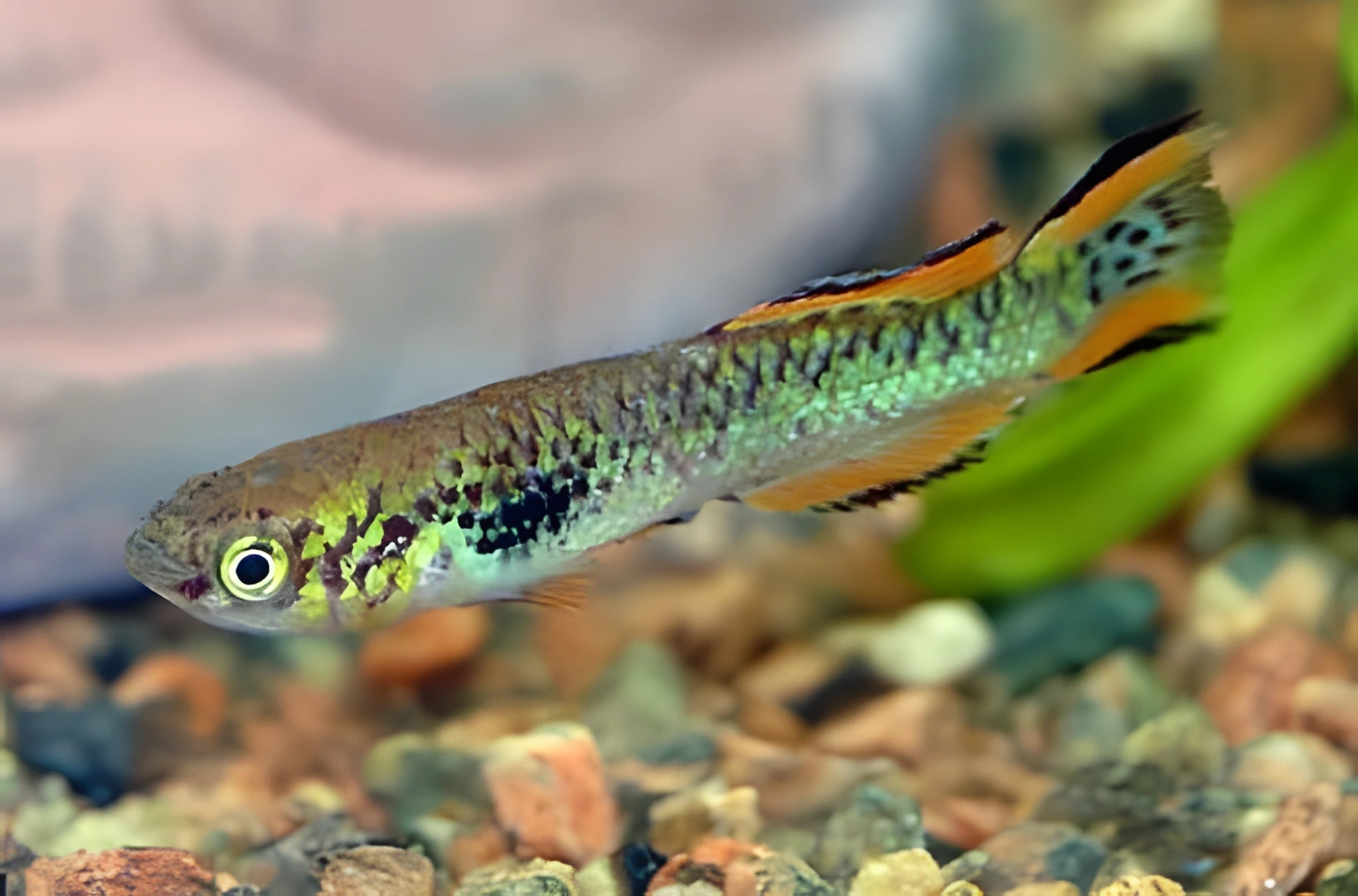
Fundulopanchax walkeri, also known as Aphyosemion walkeri, belongs to the family Nothobranchiidae. This miniature fish has an attractive appearance but is not particularly friendly. It is essentially a small predator, but in a home aquarium, it readily accepts a variety of popular foods, provided they contain all the necessary nutrients.
- Required aquarium volume
- 40 L
- Size in aquarium
- 6 cm
- Temperature
- 20 – 23 °C
- Temperament
- Aggressive / incompatible / unfriendly
Parameters
Water pHSlightly acidic (6) – Neutral (7)
Water dHSoft (5) – Hard (12)
Water salinityno salt (freshwater)
Size in aquarium6 cm
Lifespan3 years
TemperamentAggressive / incompatible / unfriendly
Toward small fishnot a predator
Required aquarium volume40 L
Lightingdimmed
Substrateany, but dark
Water flowweak
FeedingFloating (protein)
CareHarem (1 male and several females)
Description
Adults reach a length of 5–6 cm. Males are distinguished by their bright bluish coloration, adorned with red spots on the sides of their bodies, and their fins are yellow. Females look significantly more modest: their coloration is grayish, their fins are transparent, and characteristic speckles can often be seen on their bodies.
Habitat
The natural habitat of this species is the African continent, specifically the territories of modern Ghana and Côte d'Ivoire. Aphyosemion walkeri is found in small streams, lakes, and swampy areas located in coastal zones among tropical forests and savannas.
Behavior and Compatibility
Despite its size, this fish is quite aggressive and will attack smaller tank mates. It can only coexist with large, peaceful species that, in turn, will not perceive it as potential prey. The optimal keeping option is a species tank with a ratio of 1 male to 3–4 females.
Care and Maintenance
A group of 3–4 individuals will be comfortable in an aquarium of 40 liters or more. Dark substrate is recommended for decor, as well as creating areas with dense vegetation and driftwood to provide hiding places. Floating plants on the surface will also have a positive effect on the environment, helping to diffuse light and create a shaded effect. When setting up an aquarium, several important features of this species should be considered: Aphyosemion walkeri tolerates strong water movement poorly, is prone to jumping out of the aquarium, and prefers lower temperatures compared to other related Killifish species.
Diet
As a carnivorous species, Fundulopanchax walkeri prefers live or frozen foods such as Daphnia, bloodworms, and Artemia. On occasion, it may eat fry or other very small fish that fit into its mouth. The daily diet can be supplemented with specialized dry foods, the main thing is that they contain protein and other animal-derived proteins necessary for the healthy development of these fish.
Breeding and Reproduction
Given favorable conditions, the appearance of offspring is quite expected. The spawning period lasts about two weeks, during which the female lays 10 to 30 eggs daily. Spawning most often occurs among thickets of low-growing plants or on mosses. To protect the eggs from being eaten, it is recommended to immediately transfer them to a separate container with similar water parameters. Egg development takes up to 3 weeks. Fry should be kept at a very low water level, gradually increasing it as they grow. It is important to note that eggs are prone to developing a white coating, which is a fungus; without timely intervention, it can lead to the death of the entire clutch.
Diseases
Health problems usually arise only as a result of injuries or keeping in unsuitable conditions, which leads to a weakening of the immune system and, as a rule, provokes the development of various diseases. At the first signs of illness, the primary task is to check the water parameters for excesses or dangerous concentrations of toxic substances (nitrates, nitrites, ammonia, etc.). After bringing all indicators back to normal, treatment can begin. More detailed information on symptoms and treatment methods is presented in the "Aquarium Fish Diseases" section.
How to choose
When choosing individuals, attention should be paid to their activity and the condition of their skin: healthy fish should be active, without visible damage, ulcers, coating, or signs of emaciation. In the store, it is important to assess the keeping conditions — it is preferable to choose fish from aquariums with subdued lighting and hiding places, as this reduces stress in this species. Given the territorial nature of males, it is recommended to purchase a group of one male and several females to avoid conflicts in a community tank. Before purchasing, make sure the fish show interest in food, as refusal to eat can be a sign of adaptation stress or illness.
Frequently asked questions
The essentials: size, tank volume, water parameters and care
How big does Aphyosemion walkeri get?
An adult reaches 6 cm in length. Plan the tank around the maximum size: the fish quickly outgrows a cramped setup.
What size aquarium does Aphyosemion walkeri need?
The minimum recommended volume is 40 L. A smaller tank speeds up nitrate build-up and raises stress levels.
What water parameters does Aphyosemion walkeri need?
Temperature 20–23 °C, pH 6–7, hardness 5–12 dGH. Stability matters more than exact values: sudden swings are harder on the fish than a small deviation from the ideal.
How long does Aphyosemion walkeri live?
Around 3 years when kept properly. Lifespan depends directly on tank volume, water quality and a varied diet.
Is Aphyosemion walkeri aggressive?
Temperament: aggressive / incompatible / unfriendly. Keep this in mind when choosing tank mates.
How many Aphyosemion walkeri should be kept together?
Recommended setup: harem (1 male and several females). Ignoring this is a common cause of stress and disease.
What does Aphyosemion walkeri eat?
Diet type: floating (protein). Feed small portions that are finished within a couple of minutes — overfeeding does more harm than underfeeding.
What is the scientific name of Aphyosemion walkeri?
The scientific name of the species is Fundulopanchax walkeri, family Nothobranchiidae. It also appears in the literature as: Aphyosemion litoriseborus, Aphyosemion littoriseboris, Aphyosemion rubrofasciatum.