Temperature20 – 26 °C
Natural range
- Mitemele River system
- Gabon area
- Equatorial Guinea area
KillifishConservation status: Least concern LC
Other scientific names: Epiplatys striatus, Haplochilus andamanicus, Haplochilus striatus, Panchax striatus
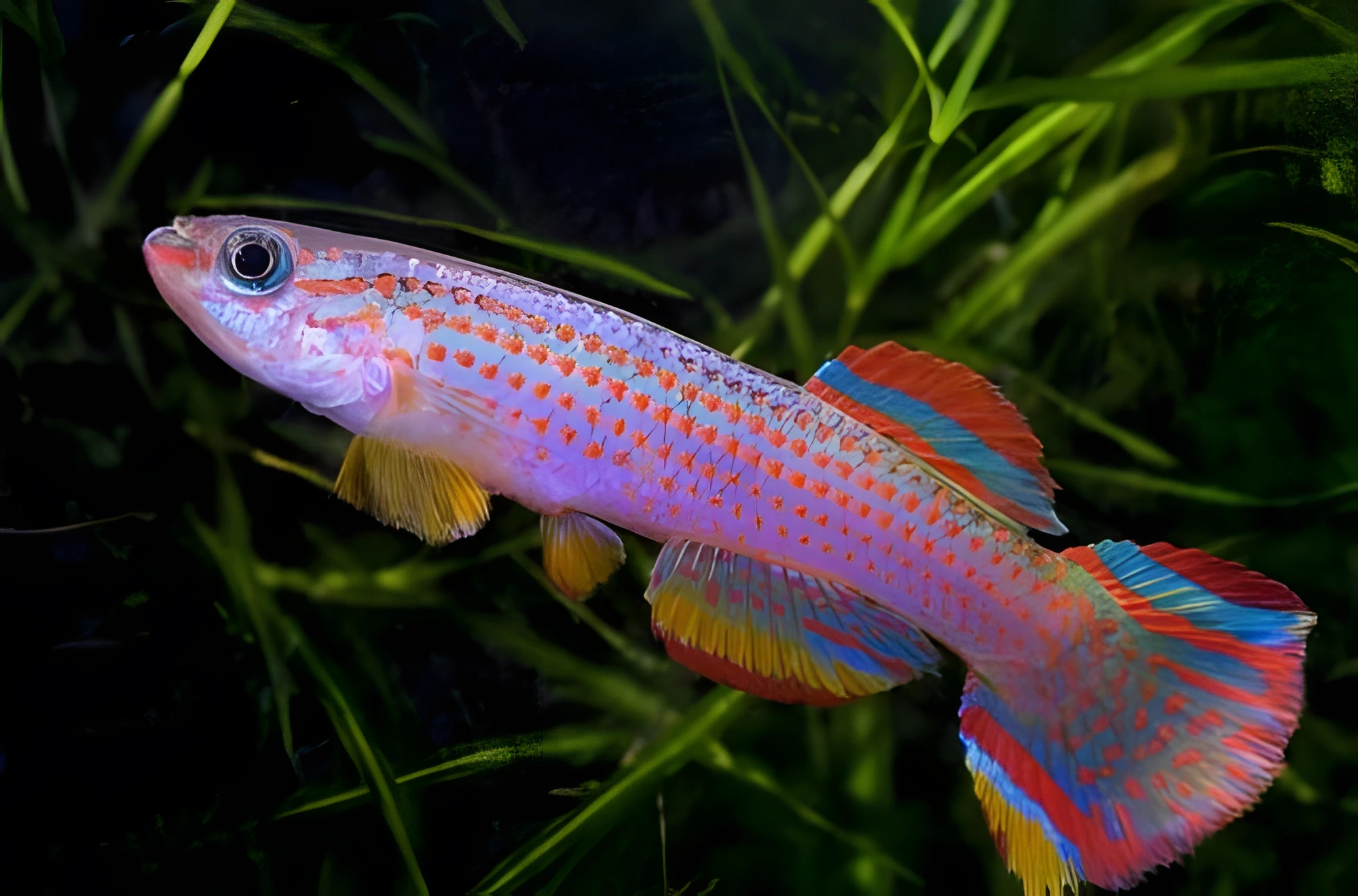
Aphyosemion striatum, also known as the Red-striped Killifish, belongs to the family Nothobranchiidae. This miniature and beautiful fish is undemanding and peaceful, making it an excellent choice for beginner aquarists. Interestingly, it is a relatively long-lived species, which is not typical for many killifish.
- Required aquarium volume
- 40 L
- Size in aquarium
- 6 cm
- Temperature
- 20 – 26 °C
- Temperament
- Semi-peaceful (including aggression during spawning / intraspecific conflicts)
Parameters
Water pHSlightly acidic (5.5) – Neutral (7)
Water dHSoft (5) – Hard (12)
Water salinityno salt (freshwater)
Size in aquarium6 cm
Lifespan4 years
TemperamentSemi-peaceful (including aggression during spawning / intraspecific conflicts)
Toward small fishnot a predator
Required aquarium volume40 L
Lightingdimmed
Substratesandy (regular, light)
Water flowmoderate or strong
FeedingMeat / protein (live, frozen, fresh)
CareHarem (1 male and several females)
Description
The fish has a slender and elongated body, complemented by elegant rounded fins and tail, with the dorsal fin significantly shifted towards the tail. Males have a pink base coloration with four red horizontal stripes running along the entire body. The fins are also adorned with a striped pattern, alternating blue and red hues. The pelvic fins are yellow. Females appear more modest: their coloration is monochromatic, their fins are transparent, and their scales have dark edges.
Habitat
Its natural habitats are located in the marshy areas of the Mitimele River system, which flows through the equatorial part of Africa, in modern-day Gabon and Equatorial Guinea. The fish prefers shallow backwaters, freshwater swamps, and streams hidden in the forest litter of tropical rainforests.
Behavior and Compatibility
This is a peaceful and somewhat shy species that can easily be intimidated by more active tankmates. It can be kept with other peaceful inhabitants, such as some livebearers, small characins, or Corydoras catfish. Intraspecific conflicts are not observed; they can successfully live both in pairs and in larger groups. The latter option is more preferable, as a school of these colorful fish looks significantly more interesting than individual specimens.
Care and Maintenance
Even a pair of these fish will feel comfortable in a relatively small 10 L tank, but for their well-being, it is still recommended to choose a larger aquarium. When decorating, try to recreate an environment as close as possible to their natural habitat. Dark sand substrate, supplemented with bogwood snags and branched branches to create shelters, will work perfectly. Create dense plant thickets, preferably including floating species, which will provide additional shading. As for water conditions, they are typical for most swamps: the water should be soft (dH value), with a slightly acidic or neutral reaction (pH value). The desired parameters can be achieved by simply boiling the water. More detailed information on pH and dH values, as well as methods for their correction, can be found in the "Hydrochemical composition of water" section. Aquarium care involves weekly substrate cleaning and replacing approximately 15–20% of the water with fresh water. If you equip the aquarium with a powerful filtration system, the intervals between maintenance procedures can be extended to two or more weeks. In the most economical option, a simple sponge filter will be sufficient. Other necessary equipment includes a heater, an aerator, and a lighting system set to create subdued light.
Diet
In natural conditions, the fish's diet consists of various invertebrates. In the aquarium, it is recommended to offer them small live or frozen foods, such as daphnia or bloodworms. Fish can also be accustomed to dry foods (granules, flakes), but this requires gradual introduction. Feed 2–3 times a day, giving an amount of food that will be eaten within 5 minutes.
Breeding and Reproduction
Breeding Aphyosemion striatum can be a challenging task; despite successful spawning in a home aquarium, the appearance of fry is not always guaranteed. Successful spawning is possible in a specially prepared tank with optimal conditions. A small 5 L aquarium, equipped with a sponge air-lift filter to prevent water stagnation and a heater, will be suitable for a breeding tank. Lighting is not required, as the eggs develop in dim light. The substrate should consist of coarse sand with dense thickets of low-growing plants, such as Java moss. Stimuli for spawning include soft, slightly acidic water (6.0–6.5 pH) and a varied diet of live or frozen foods. Since these conditions are close to those recommended for general species maintenance, the approach of the breeding period is best determined by external signs. The male becomes brighter, and the female rounds out from developing eggs. From a group of fish, select the largest and brightest male with a female and place them in the breeding aquarium. The female lays about 30 eggs per day, and the entire process can take up to a week. After spawning, the parents are returned to the main aquarium. The incubation period lasts approximately 18 days; its duration depends on temperature. The eggs are sensitive to light, so maintain dim light in the breeding aquarium. The fry emerge very small; infusoria will be the most effective solution for feeding them, and as they grow, Artemia nauplii.
Diseases
Favorable keeping conditions significantly minimize the likelihood of diseases. The use of live food can pose a certain threat, as it often carries parasites, but a healthy fish's immune system successfully copes with them. More information on symptoms and treatment methods can be found in the "Diseases of aquarium fish" section.
How to choose
When choosing individuals, attention should be paid to the cleanliness of the fins and the absence of whitish plaque, ulcers, or visible parasites on the body. A healthy fish should be active, have bright coloration (especially males), and react normally to approaching the aquarium. Avoid buying fish that look emaciated, stay at the water's surface, or exhibit apathetic behavior.
- give preference to young individuals, as they adapt more easily to new keeping conditions
- clarify with the seller the keeping conditions and diet to which the fish is accustomed
- before purchasing, make sure there are no dead individuals in the aquarium with the fish, as this may indicate problems in the system
Frequently asked questions
The essentials: size, tank volume, water parameters and care
How big does Aphyosemion striatum get?
An adult reaches 6 cm in length. Plan the tank around the maximum size: the fish quickly outgrows a cramped setup.
What size aquarium does Aphyosemion striatum need?
The minimum recommended volume is 40 L. A smaller tank speeds up nitrate build-up and raises stress levels.
What water parameters does Aphyosemion striatum need?
Temperature 20–26 °C, pH 5.5–7, hardness 5–12 dGH. Stability matters more than exact values: sudden swings are harder on the fish than a small deviation from the ideal.
How long does Aphyosemion striatum live?
Around 4 years when kept properly. Lifespan depends directly on tank volume, water quality and a varied diet.
Is Aphyosemion striatum aggressive?
Temperament: semi-peaceful (including aggression during spawning / intraspecific conflicts). Keep this in mind when choosing tank mates.
How many Aphyosemion striatum should be kept together?
Recommended setup: harem (1 male and several females). Ignoring this is a common cause of stress and disease.
What does Aphyosemion striatum eat?
Diet type: meat / protein (live, frozen, fresh). Feed small portions that are finished within a couple of minutes — overfeeding does more harm than underfeeding.
What is the scientific name of Aphyosemion striatum?
The scientific name of the species is Aphyosemion striatum, family Nothobranchiidae. It also appears in the literature as: Epiplatys striatus, Haplochilus andamanicus, Haplochilus striatus.