Temperature18 – 22 °C
Natural range
- Republic of the Congo area
- Equatorial Africa area
KillifishConservation status: Data deficient DD
Other scientific names: Aphyosemion pyrophore, Haplochilus lujae
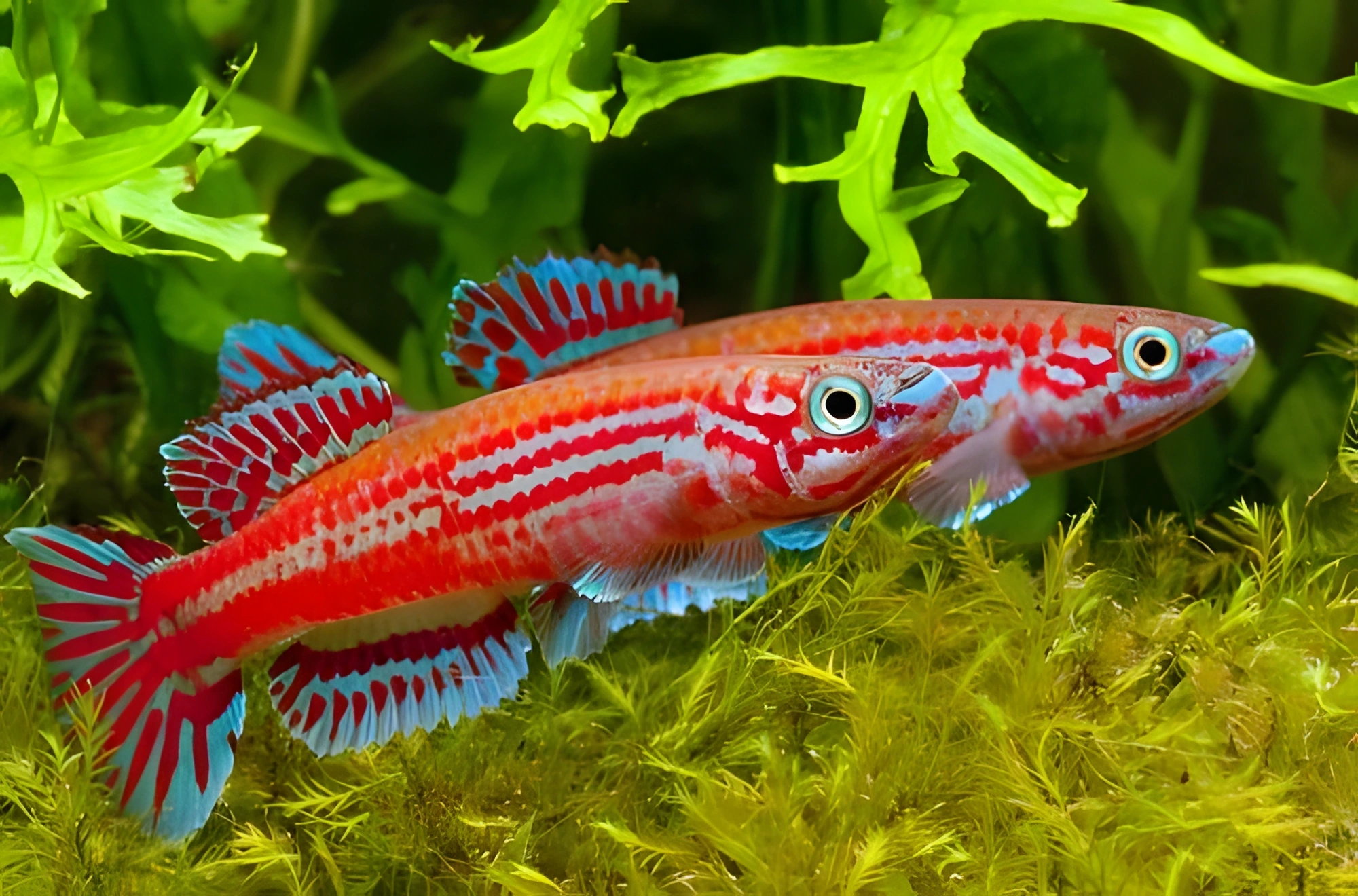
Aphyosemion ogoense, also known by its scientific name Aphyosemion ogoense, belongs to the family Nothobranchiidae. A distinctive feature of this fish is its bright and original appearance. Despite its relative ease of care and unpretentiousness, it is not often found for sale, which is due to the difficulty of breeding. This circumstance often deters aquarists. As a result, these fish can be found mainly from professional breeders or in large retail chains, while it will be difficult to find them in small pet shops or markets.
- Required aquarium volume
- 40 L
- Size in aquarium
- 5 cm
- Temperature
- 18 – 22 °C
- Temperament
- Territorial (often aggressive)
Parameters
Water pHSlightly acidic (5) – Neutral (6.5)
Water dHVery soft (1) – Medium hardness (8)
Water salinityno salt (freshwater)
Size in aquarium5 cm
Lifespan4 years
TemperamentTerritorial (often aggressive)
Toward small fishnot a predator
Required aquarium volume40 L
Lightingdimmed
Substratesand or gravel + stones/boulders
Water flowweak
FeedingAny (universal)
CarePair (male/female)
Description
Male Aphyosemion ogoense stand out with their rich red coloration and unique body pattern, formed by numerous blue or light blue speckles. Their fins and tail are framed by a blue stripe. Males are usually slightly larger than females. Females, in turn, are distinguished by more modest coloration, smaller size, and smaller fins.
Habitat
The homeland of this species is equatorial Africa, specifically the territory of the modern Republic of Congo. These fish prefer to live in small rivers that flow under the dense canopy of the tropical forest, where there is abundant aquatic vegetation and many natural shelters.
Behavior and Compatibility
This peaceful and friendly species, due to its modest size and gentle disposition, can only be kept with inhabitants of similar behavior. Any active or, moreover, large fish will certainly force Aphyosemion to constantly seek shelter. It is best to keep them in a species-specific aquarium.
Care and Maintenance
A group of 3–5 Aphyosemion ogoense will feel comfortable in an aquarium of 40 L or more. It is advisable to provide areas with dense vegetation and floating plants, as well as hiding places made of snags, roots, and tree branches. Sand and/or a peat-based substrate are suitable as substrate. Water conditions should maintain a slightly acidic pH and low hardness values. In this regard, when initially filling the aquarium and during subsequent partial water changes, preliminary water preparation will be required, as direct use of tap water may be undesirable. More detailed information on pH and dGH parameters, as well as methods for their correction, can be found in the section "Hydrochemical composition of water". The standard equipment set for such an aquarium includes a heater, aerator, lighting system, and filtration system. Aphyosemion ogoense prefers low lighting and the absence of strong internal currents. Therefore, low or medium power lamps should be used, and the filter should be positioned so that the outgoing water flows are diffused by an obstacle, such as the aquarium wall or decorative elements. In a stable, balanced aquarium, care is reduced to weekly water changes of 10–13% of the volume, regular cleaning of the substrate from waste products, and, as necessary, cleaning the glass from organic deposits.
Diet
In a home aquarium, these fish readily accept almost all types of high-quality dry foods, such as flakes and granules. It is recommended to supplement their diet several times a week with live or frozen foods, such as daphnia, artemia, or bloodworms. Feed 2–3 times a day, offering an amount of food that the fish can eat in 3–5 minutes; it is important to promptly remove all uneaten remains.
Breeding and Reproduction
For breeding, it is recommended to use a separate spawning tank, which will protect the offspring from both parents and other inhabitants. A small tank of about 20 liters will be suitable for this purpose. As for equipment, a simple sponge air-driven filter, a light, and a heater are sufficient, although the latter may not be needed if the water temperature naturally reaches the required values (see below). Several large plants can be used as decor. The use of substrate is not recommended to simplify future maintenance, although in nature, the fish spawn in dense thickets. A fine-mesh net can be placed on the bottom, through which the eggs can pass. This design is due to the need to protect the eggs, as parents tend to eat them, and also to allow for easy removal of the eggs to another container. The chosen pair of adult fish are placed in the spawning tank. Maintaining a cool water temperature between 18–20°C with a slightly acidic pH (6.0–6.5) and including meaty, live, or frozen foods in the daily diet stimulate spawning. It is extremely important to frequently clean the substrate of food debris and organic waste (excrement), as water quickly becomes polluted in a confined space. The female lays eggs in portions of 10–20 daily for two weeks. Each batch of eggs should be carefully removed from the aquarium (this is why it is recommended not to use substrate) and transferred to a separate container, such as a tray with high sides, where the water level will be only 1–2 cm, with the addition of 1–3 drops of methylene blue, depending on the volume. This substance prevents the development of fungal infections. It is important to remember that the tray with eggs should be kept in a dark and warm place, as the eggs are very sensitive to light. The incubation period lasts from 18 to 22 days. Eggs can also be placed in moist/damp peat and stored in the dark at the required temperature. Fry do not appear simultaneously but in batches; newly hatched fry should be transferred to the spawning tank, where the parents should no longer be present by then. Approximately two days later, the first food, consisting of microscopic organisms such as Artemia nauplii and Paramecium, can be offered. In the second week of life, live or frozen foods such as Artemia, Daphnia, and others can be introduced. As during spawning, pay increased attention to water purity. In the absence of an effective filtration system, it is necessary to regularly, at least every few days, clean the spawning tank and replace part of the water with fresh water.
Diseases
The best protection against diseases is a balanced, established biological aquarium system with optimal water parameters and high-quality nutrition. In most cases, fish health problems arise due to improper keeping conditions; this is what should be addressed first when signs of distress appear. More complete information on symptoms and treatment methods is presented in the section “Diseases of Aquarium Fish.”
How to choose
When choosing Aphyosemion ogoense, you should consult specialized breeders, as the species is rarely found in mass sale. Healthy individuals should be active, have clean fins without signs of damage or film, and a firm body without visible deformities. Avoid purchasing fish that appear sluggish, constantly stay near the surface, or have a sunken belly.
- Check the condition of the scales: they should be tightly pressed against the body.
- Check for the absence of spots or sores on the skin.
- Make sure the fish do not show signs of shyness when approaching the aquarium in the store.
Since this species is sensitive to environmental conditions, ask the seller about the water parameters in which the fish were kept for subsequent smooth adaptation in your home aquarium.
Frequently asked questions
The essentials: size, tank volume, water parameters and care
How big does Aphyosemion ogoense get?
An adult reaches 5 cm in length. Plan the tank around the maximum size: the fish quickly outgrows a cramped setup.
What size aquarium does Aphyosemion ogoense need?
The minimum recommended volume is 40 L. A smaller tank speeds up nitrate build-up and raises stress levels.
What water parameters does Aphyosemion ogoense need?
Temperature 18–22 °C, pH 5–6.5, hardness 1–8 dGH. Stability matters more than exact values: sudden swings are harder on the fish than a small deviation from the ideal.
How long does Aphyosemion ogoense live?
Around 4 years when kept properly. Lifespan depends directly on tank volume, water quality and a varied diet.
Is Aphyosemion ogoense aggressive?
Temperament: territorial (often aggressive). Keep this in mind when choosing tank mates.
How many Aphyosemion ogoense should be kept together?
Recommended setup: pair (male/female). Ignoring this is a common cause of stress and disease.
What does Aphyosemion ogoense eat?
Diet type: any (universal). Feed small portions that are finished within a couple of minutes — overfeeding does more harm than underfeeding.
What is the scientific name of Aphyosemion ogoense?
The scientific name of the species is Aphyosemion ogoense, family Nothobranchiidae. It also appears in the literature as: Aphyosemion pyrophore, Haplochilus lujae.