Temperature23 – 26 °C
Natural range
- Niger Delta area
- Southern Nigeria area
- Southwestern Cameroon area
KillifishConservation status: Endangered EN
Other scientific names: Aphyosemion caeruleum, Aphyosemion coeruleum, Aphyosemion gulare, Aphyosemion sjoestedti, Aphyosemion sjostedti, Aphyosemion zimmeri
The Blue Gularis Killifish, scientifically known as Fundulopanchax sjostedti, belongs to the family Nothobranchiidae. Previously, this species was classified under the genus Aphyosemion. It can be found for sale under the names “Pheasant Blue” or “Gularis,” which are translations or transcriptions of the English commercial name Blue Gularis.
- Required aquarium volume
- 80 L
- Size in aquarium
- 13 cm
- Temperature
- 23 – 26 °C
- Temperament
- Semi-peaceful (including aggression during spawning / intraspecific conflicts)
Parameters
Water pHSlightly acidic (6) – Slightly alkaline (8)
Water dHSoft (5) – Very hard (20)
Water salinityno salt (freshwater)
Size in aquarium13 cm
Lifespan3 years
TemperamentSemi-peaceful (including aggression during spawning / intraspecific conflicts)
Toward small fishnot a predator
Required aquarium volume80 L
Lightingdimmed
Substrateany (no restrictions)
Water flownone or stagnant (no flow)
FeedingHigh protein (predominantly meat)
CareHarem (1 male and several females)
Description
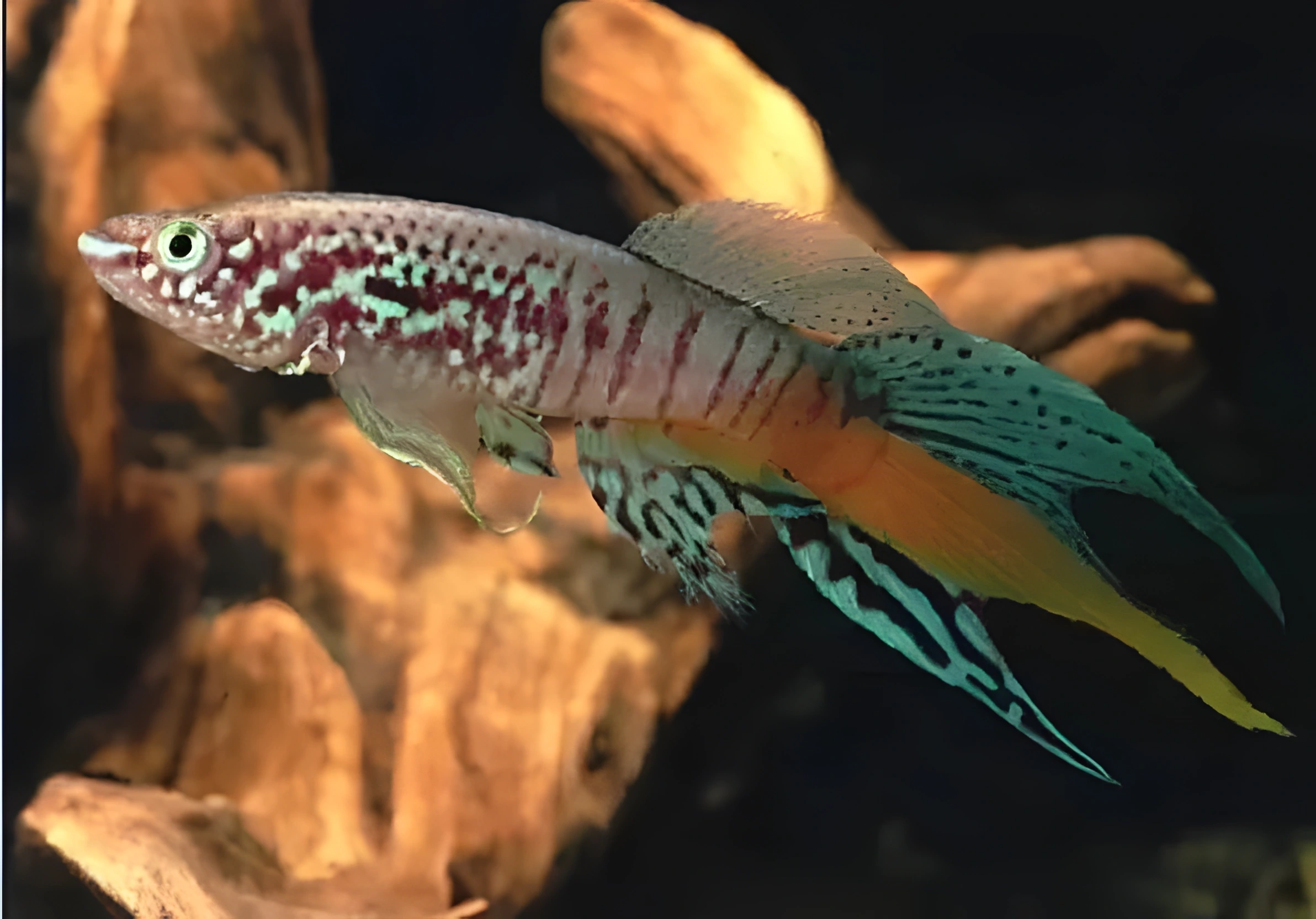
Among the group of Killifish, the Blue Gularis Killifish stands out for its size, being the largest representative. Adult specimens can reach a length of about 13 cm. It is worth noting that maximum size and a brighter, more variegated coloration are characteristic of males compared to females. Breeders have developed several strains that differ in the predominance of certain hues. Fish with intense orange and yellow coloration, known as the “USA blue” variety, are particularly popular. It is noteworthy that the reason for the word “blue” in the name remains unclear. In addition to its impressive color palette, the Blue Gularis Killifish attracts attention with its large fins, whose coloration harmonizes with the body. The massive tail, colored in yellow-orange tones, resembles flames.
Habitat
The natural habitat of this fish is on the African continent. It is found in the Niger River delta, in southern and southeastern Nigeria, as well as in southwestern Cameroon. It prefers temporary swamps formed by river floods and marshy areas of coastal tropical forests.
Behavior and Compatibility
The interaction between males is characterized by a high degree of hostility. Therefore, when keeping several male individuals together, spacious aquariums of several hundred liters are required to prevent constant skirmishes. Females, in contrast, are more peaceful and get along easily with each other. In a small aquarium, a group of one male and 2–3 females is considered optimal. If there is only one female, she risks becoming the object of constant attacks from the male. The Blue Gularis Killifish shows good compatibility with other species of comparable size. Such tankmates can include peaceful cichlids, large characins, corydoras, and plecos, as well as other similar fish.
Care and Maintenance
For keeping a group of 3–4 individuals, the optimal aquarium volume starts from 80 liters. For decoration, it is recommended to use dark substrate, enriched with peat or similar substrates that can help acidify the water. It is desirable to place pieces of bogwood, natural snags, branches, and fallen leaves on the bottom. An important element of the decor is aquatic plants, including floating ones, which help diffuse light. The aquarium must be equipped with a lid or other device to prevent fish from jumping out. This species is versatile in terms of water parameters. Despite its origin from swampy waters, the Blue Gularis Killifish can adapt even to an alkaline environment with high GH values. Thus, the range of acceptable keeping conditions for it is quite wide. It prefers high-protein foods. It should be noted that the fish may eat fry and very small conspecifics. Their diet should consist of fresh, frozen, or live foods such as daphnia, bloodworms, or large artemia. Dry foods are recommended only as supplementary nutrition.
Diet
The diet of Blue Gularis Killifish should consist of fresh, frozen, or live protein-rich foods such as daphnia, bloodworms, or large artemia. Dry foods are recommended only as supplementary nutrition. It should be noted that the fish may eat fry and very small conspecifics. If a large number of Blue Gularis Killifish (several males) or other fish species are kept in the aquarium, a separate tank is recommended for successful breeding. For spawning, one male and several females are placed in it – this is the minimum group composition. The setup of the spawning aquarium implies the presence of a special substrate that will be easy to remove afterward. This can be fibrous substrate based on coconut husk, a dense layer of aquatic mosses that can be removed and dried without regret, as well as other materials, including artificial ones. Other decorations are not essential. A simple air-driven filter is sufficient for filtration. Water parameters should be acidic and soft in terms of pH and GH. The temperature for most strains of Blue Gularis Killifish should not exceed 21°C. The exception is the “USA blue” variety, which, on the contrary, requires a temperature below 21°C. Under favorable conditions and with a balanced diet, spawning usually occurs quickly. In aquarium conditions, the fish lay eggs almost anywhere suitable. It is important to detect the eggs in a timely manner and either transfer the adult fish back to the main aquarium or remove the substrate with the eggs and move it to a separate tank. Otherwise, some of the eggs may be eaten. The tank or spawning aquarium with eggs must be kept in the dark, as the eggs are sensitive to light, and checked daily for fungus. If affected eggs are found, they should be removed with a pipette. The incubation period is about 21 days. It is important to note that the eggs can survive without water in dry substrate for up to 12 weeks. This unique feature is due to the fact that in their natural environment, fertilized eggs often end up in temporary bodies of water that dry up during the dry season.
Breeding and Reproduction
If a large number of Blue Gularis Killifish (several males) or other fish species are kept in the aquarium, a separate tank is recommended for successful breeding. For spawning, one male and several females are placed in it – this is the minimum group composition. The setup of the spawning aquarium implies the presence of a special substrate that will be easy to remove afterward. This can be fibrous substrate based on coconut husk, a dense layer of aquatic mosses that can be removed and dried without regret, as well as other materials, including artificial ones. Other decorations are not essential. A simple air-driven filter is sufficient for filtration. Water parameters should be acidic and soft in terms of pH and GH. The temperature for most strains of Blue Gularis Killifish should not exceed 21°C. The exception is the “USA blue” variety, which, on the contrary, requires a temperature below 21°C. Under favorable conditions and with a balanced diet, spawning usually occurs quickly. In aquarium conditions, the fish lay eggs almost anywhere suitable. It is important to detect the eggs in a timely manner and either transfer the adult fish back to the main aquarium or remove the substrate with the eggs and move it to a separate tank. Otherwise, some of the eggs may be eaten. The tank or spawning aquarium with eggs must be kept in the dark, as the eggs are sensitive to light, and checked daily for fungus. If affected eggs are found, they should be removed with a pipette. The incubation period is about 21 days. It is important to note that the eggs can survive without water in dry substrate for up to 12 weeks. This unique feature is due to the fact that in their natural environment, fertilized eggs often end up in temporary bodies of water that dry up during the dry season.
Diseases
This species is sensitive to sudden changes in water parameters, which can lead to stress and the development of secondary bacterial infections. To prevent diseases, it is necessary to maintain a stable environment, avoid overfeeding, and regularly perform partial water changes. Fish are prone to parasitic infestations under poor keeping conditions, so it is important to maintain aquarium hygiene and use high-quality live foods that have been pre-treated.
How to choose
When selecting individuals, attention should be paid to the activity of the fish and the absence of damage to the fins or skin. Healthy specimens should have bright coloration appropriate to their gender and show interest in food. Avoid buying fish with signs of emaciation, sluggish behavior, or visible spots on the body. It is recommended to clarify the keeping conditions at the store, as a sharp transition from hard alkaline water to acidic and soft water can negatively affect the fish's health.
Frequently asked questions
The essentials: size, tank volume, water parameters and care
How big does Blue Gularis Killifish get?
An adult reaches 13 cm in length. Plan the tank around the maximum size: the fish quickly outgrows a cramped setup.
What size aquarium does Blue Gularis Killifish need?
The minimum recommended volume is 80 L. A smaller tank speeds up nitrate build-up and raises stress levels.
What water parameters does Blue Gularis Killifish need?
Temperature 23–26 °C, pH 6–8, hardness 5–20 dGH. Stability matters more than exact values: sudden swings are harder on the fish than a small deviation from the ideal.
How long does Blue Gularis Killifish live?
Around 3 years when kept properly. Lifespan depends directly on tank volume, water quality and a varied diet.
Is Blue Gularis Killifish aggressive?
Temperament: semi-peaceful (including aggression during spawning / intraspecific conflicts). Keep this in mind when choosing tank mates.
How many Blue Gularis Killifish should be kept together?
Recommended setup: harem (1 male and several females). Ignoring this is a common cause of stress and disease.
What does Blue Gularis Killifish eat?
Diet type: high protein (predominantly meat). Feed small portions that are finished within a couple of minutes — overfeeding does more harm than underfeeding.
What is the scientific name of Blue Gularis Killifish?
The scientific name of the species is Fundulopanchax sjostedti, family Nothobranchiidae. It also appears in the literature as: Aphyosemion caeruleum, Aphyosemion coeruleum, Aphyosemion gulare.