Temperature20 – 26 °C
Natural range
- Togo area
- Benin area
- Nigeria area
- West Africa area
Killifish
Aphyosemion Filamentosum, scientifically known as Fundulopanchax filamentosus, belongs to the family Nothobranchiidae. This fish attracts with its bright and beautiful appearance but is quite rare in aquariums due to the difficulties encountered during breeding. However, keeping the species itself does not cause much trouble, making it quite undemanding.
- Required aquarium volume
- 50 L
- Size in aquarium
- 5 cm
- Temperature
- 20 – 26 °C
- Temperament
- Peaceful (regular)
Parameters
Water pHSlightly acidic (6) – Neutral (7)
Water dHVery soft (1) – Hard (12)
Water salinityno salt (freshwater)
Size in aquarium5 cm
Lifespan2 years
TemperamentPeaceful (regular)
Toward small fishnot a predator
Required aquarium volume50 L
Lightingdimmed
Substrateany, but dark
Water flownone or stagnant (no flow)
FeedingMeat / protein (live, frozen, fresh)
CareHarem (1 male and several females)
Description
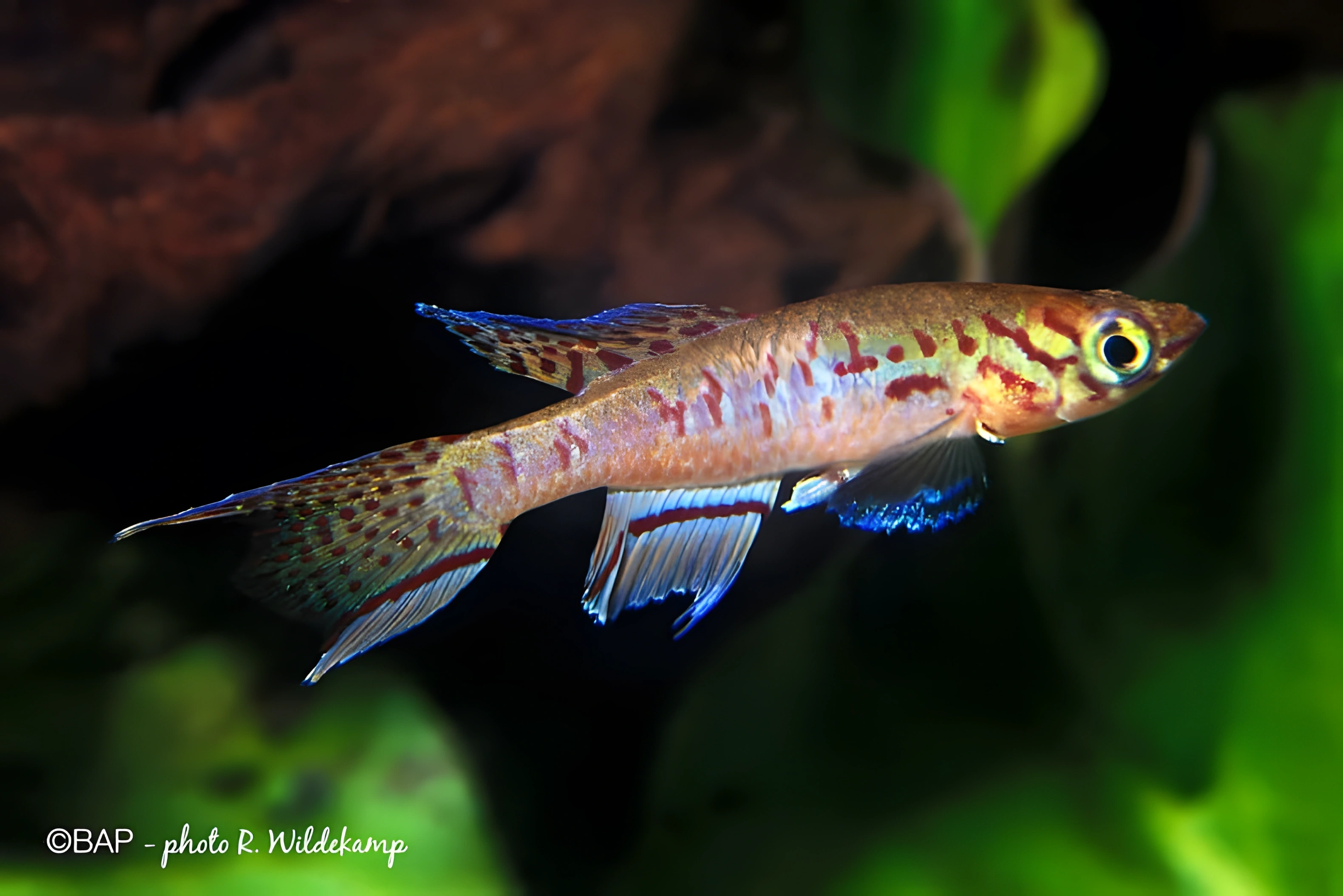
Adults reach approximately 5 cm in length. Their coloration is predominantly blue. The head, dorsal fin, and upper part of the caudal fin are marked with characteristic red-burgundy speckles. The anal fin, like the lower area of the caudal fin, is adorned with a horizontal burgundy-red stripe framed by a blue edge. It is important to note that such a vibrant pattern and rich coloration are typical only for males. Females, on the other hand, have a more modest color scheme.
Habitat
The homeland of this fish is the African continent, where it inhabits the territories of Togo, Benin, and Nigeria. Its natural habitat is marshy areas and swampy sections of streams, often found in coastal tropical forests.
Behavior and Compatibility
This fish is distinguished by its peaceful and quite active disposition. Competition for female attention may be observed among males, sometimes leading to minor skirmishes in small aquariums, but serious injuries are extremely rare. In small tanks, it is preferable to keep a group consisting of one male and several females. Aphyosemion Filamentosum coexists well with other fish species of similar size.
Care and Maintenance
For comfortable keeping of a group of 3–4 fish, an aquarium of at least 50 liters will be required. A dark, soft substrate is recommended, possibly with the addition of peat or its derivatives, which will help create a slightly acidic environment. It is important to provide many shelters, which can be branches, snags, fallen leaves, and dense thickets of shade-loving plants. Lighting should be subdued, and floating plants can help diffuse light and create additional shaded areas. Water parameters should correspond to acidic pH values and low GH values (soft water). The comfortable water temperature is within 21–23°C, but small fluctuations are permissible. The aquarium must be covered with a lid or use another device to prevent fish from jumping out. For water filtration, a simple air-driven sponge filter is recommended, which will effectively handle biological purification in small aquariums and will not create excessive water flow, as Aphyosemion Filamentosum prefers calm, still waters. Their diet should primarily consist of high-protein foods, such as live or frozen bloodworms, large artemia, and daphnia. Dry foods can only serve as a supplement to the main diet.
Diet
The diet of these fish should primarily consist of high-protein foods, such as live or frozen bloodworms, large artemia, daphnia, and similar. Dry foods are recommended only as a supplement. Breeding is preferably carried out in a separate tank. However, it is quite problematic to determine the exact moment when the fish should be moved to the spawning aquarium. Because of this, Aphyosemions often breed directly in their usual habitat. It has been observed that a protein-rich diet (ideally, live foods) combined with a gradual increase in temperature to 24–27°C, and then maintaining it at this level, stimulates spawning. Such an environment mimics the beginning of the dry season—the natural breeding period for Aphyosemions. In the wild, fish often inhabit temporary bodies of water that can dry up. After spawning, the eggs remain in the substrate layer of the dried-up body of water, staying in a semi-moist substrate for several months until the rainy season arrives. A similar situation must be created in aquarium conditions. The fish lay eggs directly into the substrate. The substrate is then removed from the tank, placed in a container with a perforated lid for ventilation, and left in a dark place for 6–10 weeks. The container should be stored without access to light, and the substrate should be periodically moistened to avoid complete drying out. Coconut fiber or other similar fibrous material is recommended for the substrate. In some cases, a layer of aquatic mosses and ferns that can be safely dried is used. After 6–10 weeks, the substrate with the eggs is placed in water at about 20°C. Hatching of fry occurs within a few days. After the offspring appear, the temperature is gradually raised to the recommended values.
Breeding and Reproduction
Breeding these fish is desirable in a separate tank. However, determining the appropriate time to transfer the fish to the spawning aquarium can be quite challenging. For this reason, Aphyosemions often breed directly in the community tank. A diet rich in proteins (live foods are preferred), as well as a gradual increase in water temperature to 24–27°C with subsequent maintenance at this level, serves as a stimulus for spawning. Such conditions mimic the onset of the dry season, which is the natural breeding period for Aphyosemions. In their natural habitat, these fish are often found in temporary, drying-up bodies of water. After spawning, the eggs remain in the substrate layer of the dried-up body of water, staying in a semi-moist substrate for several months until the rainy season arrives. Similar conditions must be recreated in the aquarium. The fish lay eggs directly into the substrate. This substrate is then removed from the aquarium, placed in a container with a perforated lid for ventilation, and left in a dark place for 6 to 10 weeks. The container must be kept away from light. It is important to prevent the substrate from completely drying out by periodically moistening it. Coconut fiber or similar fibrous materials are recommended as a substrate. Sometimes, a layer of aquatic mosses and ferns that can be safely dried is also used. After the specified 6–10 weeks, the substrate with the eggs is placed in water at a temperature of about 20°C. The appearance of fry usually occurs within a few days. After they appear, the water temperature should be gradually brought up to the recommended values.
Diseases
The species is susceptible to diseases typical for killifish when keeping conditions are violated. The main risks are associated with bacterial infections and fungal infections, which often develop due to stress, poor water quality, or sudden temperature fluctuations. Fish are sensitive to the accumulation of organic waste, so regular water changes are an essential preventive measure. If environmental parameters are not maintained, oodinium disease may develop, manifesting as small golden spots on the body.
How to choose
When selecting individuals, preference should be given to active fish with clean fins and no visible damage to their scales. Avoid specimens with signs of emaciation, sunken bellies, or unnatural behavior, such as constantly hovering near the surface or trying to scratch themselves against the substrate. In the store, the fish should display the characteristic coloration for the species; paleness may indicate severe stress or poor health.
Frequently asked questions
The essentials: size, tank volume, water parameters and care
How big does Aphyosemion filamentosum get?
An adult reaches 5 cm in length. Plan the tank around the maximum size: the fish quickly outgrows a cramped setup.
What size aquarium does Aphyosemion filamentosum need?
The minimum recommended volume is 50 L. A smaller tank speeds up nitrate build-up and raises stress levels.
What water parameters does Aphyosemion filamentosum need?
Temperature 20–26 °C, pH 6–7, hardness 1–12 dGH. Stability matters more than exact values: sudden swings are harder on the fish than a small deviation from the ideal.
How long does Aphyosemion filamentosum live?
Around 2 years when kept properly. Lifespan depends directly on tank volume, water quality and a varied diet.
Is Aphyosemion filamentosum aggressive?
Temperament: peaceful (regular). Keep this in mind when choosing tank mates.
How many Aphyosemion filamentosum should be kept together?
Recommended setup: harem (1 male and several females). Ignoring this is a common cause of stress and disease.
What does Aphyosemion filamentosum eat?
Diet type: meat / protein (live, frozen, fresh). Feed small portions that are finished within a couple of minutes — overfeeding does more harm than underfeeding.
What is the scientific name of Aphyosemion filamentosum?
The scientific name of the species is Fundulopanchax filamentosu, family Nothobranchiidae.