Temperature20 – 24 °C
Natural range
- Benin area
- Togo area
- Nigeria area
- Lower Niger River Basin
KillifishConservation status: Least concern LC
Other scientific names: Aphyosemion multicolor, Aphyosemion nigri, Aphyosemion rubrostictum, Fundulopanchax bitaeniatus, Fundulopanchax multicolor, Fundulus bitaeniatus
The Two-striped Aphyosemion, scientifically known as Aphyosemion bitaeniatum, belongs to the family Nothobranchiidae, or nothobranchs. These vibrant fish are not particularly demanding to keep and adapt easily to various conditions. However, it's worth noting their relatively short life cycle, which typically lasts only 1–2 seasons.
- Required aquarium volume
- 40 L
- Size in aquarium
- 4 – 5 cm
- Temperature
- 20 – 24 °C
- Temperament
- Peaceful (regular)
Parameters
Water pHSlightly acidic (5) – Neutral (6.5)
Water dHVery soft (1) – Soft (6)
Water salinityno salt (freshwater)
Size in aquarium4 – 5 cm
Lifespan3 years
TemperamentPeaceful (regular)
Toward small fishnot a predator
Required aquarium volume40 L
Lightingdimmed
Substrateany (no restrictions)
Water flownone or stagnant (no flow)
FeedingHigh protein (predominantly meat)
CareSmall group (3–4 individuals)
Description
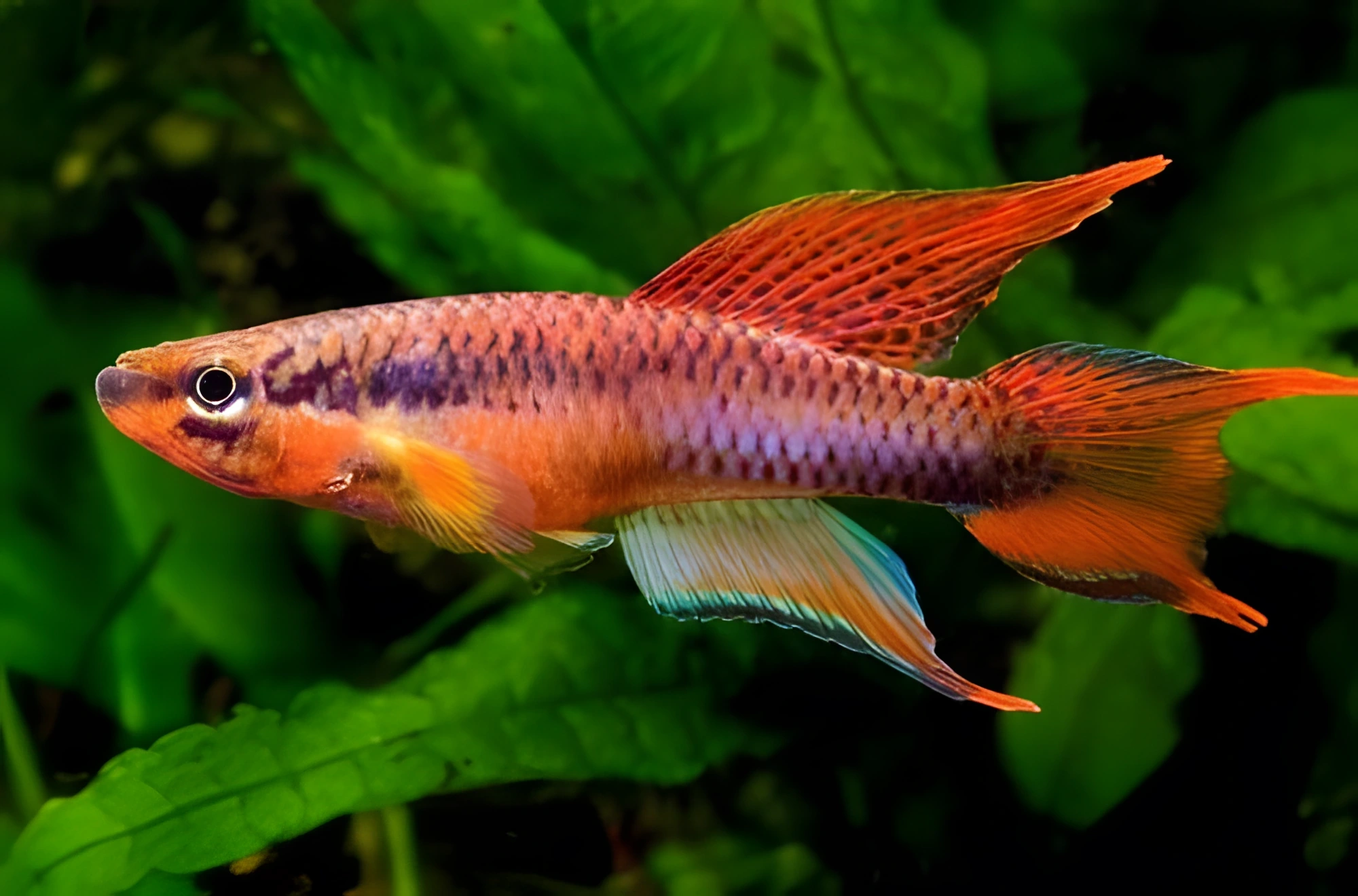
Adults grow up to 4–5 cm. Males are distinguished by more colorful markings and larger fins—dorsal, anal, and caudal. These fins are adorned with red hues, turquoise edges, and a pattern of fine speckles. Two dark stripes run along the males' bodies, extending from the head to the tail. There is a special variety called 'Lagos Red,' characterized by a predominance of rich red color. Females, on the other hand, are much more modest: their fins are short and translucent, and their bodies have a gray-silver hue. Like males, females also have a two-striped pattern on their bodies.
Habitat
The natural habitat of these fish spans equatorial Africa. They are widely found in the swampy coastal areas of Benin, Togo, and Nigeria, as well as in the lower reaches of the Niger River. Aphyosemions inhabit shallow streams, backwaters, and ponds formed among the forest litter in humid tropics. The depth of such bodies of water usually ranges from 1 to 30 cm, and they are often temporary formations that can completely dry up. The bottom in such places is thickly covered with fallen leaves, branches, and other organic matter.
Behavior and Compatibility
Killifish are usually kept in species-specific aquariums. Nevertheless, cohabitation with other peaceful, tiny species is permissible. Male Two-striped Aphyosemions exhibit territorial behavior and may compete with each other. For small aquariums, it is advisable to acquire a group with one male and several females.
Care and Maintenance
In their natural environment, Two-striped Aphyosemions live in conditions that many other fish species would find extreme. Such high adaptability significantly simplifies the care of these fish. They can be kept in small aquariums, from 20 to 40 liters. The water temperature should not exceed 24°C. Although the fish prefer soft, acidic water, they tolerate higher dGH values quite well. It is important to provide the aquarium with a lid or not fill it completely to prevent the fish from jumping out, as in nature, they use jumps to move from drying ponds to new ones. For decoration, it is recommended to use an abundance of floating and rooted plants, and to create a layer of fallen leaves on the bottom. More details on choosing suitable leaves for an aquarium can be found in a separate article. Lighting should be subdued. Any substrate will do, but for breeding, it is better to use specialized fibrous materials or thickets of fine-leaved mosses.
Diet
The diet of these fish should primarily consist of live or frozen foods, such as bloodworms, daphnia, artemia, as well as mosquito larvae and Drosophila fruit flies. If desired, they can be accustomed to dry foods, but it is important that such foods are rich in protein.
Breeding and Reproduction
If the fish live in a community tank, it is advisable to set aside a separate tank for breeding. Optimal conditions are achieved in soft (up to 6 dGH) and slightly acidic (around 6.5 pH) water at a temperature of 22–24°C. It is important to feed the breeding pair high-protein foods or exclusively live foods. Eggs are laid in dense moss or a special spawning substrate. Egg development takes 12 to 14 days. The hatched fry should also be transferred to a separate container with identical water parameters. During the first 2–3 weeks, active filtration should be avoided to prevent the young from being sucked into the filter. Partial water changes with fresh water are performed once a week, and uneaten food residues must be promptly removed to avoid excessive pollution.
Diseases
Favorable keeping conditions significantly reduce the risk of diseases. The use of live food can pose a threat, as it often carries parasites, but the immune system of healthy fish successfully copes with them. Detailed information on symptoms and treatment methods can be found in the 'Diseases of Aquarium Fish' section.
How to choose
When choosing a Two-striped Aphyosemion, preference should be given to individuals with clean fins, free from signs of damage, film, or spots. A healthy fish should be active, display natural coloration, and show interest in its surroundings. Avoid specimens with clamped fins, uncharacteristic behavior (lethargy or chaotic movements), or signs of emaciation.
- Inspect the fish for the absence of parasites and sores on its body.
- Ensure that the male exhibits characteristic bright coloration, and the female does not appear emaciated.
- Ask the seller about the type of food the fish is accustomed to, as adaptation to dry mixes can be difficult. Quarantine after purchase is mandatory, as fish can be sensitive to changes in keeping conditions and pathogens carried by live food.
Frequently asked questions
The essentials: size, tank volume, water parameters and care
How big does Two-striped Aphyosemion get?
An adult reaches 4–5 cm in length. Plan the tank around the maximum size: the fish quickly outgrows a cramped setup.
What size aquarium does Two-striped Aphyosemion need?
The minimum recommended volume is 40 L. A smaller tank speeds up nitrate build-up and raises stress levels.
What water parameters does Two-striped Aphyosemion need?
Temperature 20–24 °C, pH 5–6.5, hardness 1–6 dGH. Stability matters more than exact values: sudden swings are harder on the fish than a small deviation from the ideal.
How long does Two-striped Aphyosemion live?
Around 3 years when kept properly. Lifespan depends directly on tank volume, water quality and a varied diet.
Is Two-striped Aphyosemion aggressive?
Temperament: peaceful (regular). Keep this in mind when choosing tank mates.
How many Two-striped Aphyosemion should be kept together?
Recommended setup: small group (3–4 individuals). Ignoring this is a common cause of stress and disease.
What does Two-striped Aphyosemion eat?
Diet type: high protein (predominantly meat). Feed small portions that are finished within a couple of minutes — overfeeding does more harm than underfeeding.
What is the scientific name of Two-striped Aphyosemion?
The scientific name of the species is Aphyosemion bitaeniatum, family Nothobranchiidae. It also appears in the literature as: Aphyosemion multicolor, Aphyosemion nigri, Aphyosemion rubrostictum.