Temperature20 – 27 °C
Natural range
- Cameroon area
KillifishConservation status: Endangered EN
Other scientific names: Aphyosemion amieti
Aphyosemion Amieti, known scientifically as Fundulopanchax amieti, belongs to the family Nothobranchiidae. These fish originate from the central regions of Africa, predominantly inhabiting the Sanaga River basin in Cameroon. Their preferred habitats are swampy areas of small rivers and streams, often hidden under the dense canopy of tropical forests.
- Required aquarium volume
- 40 L
- Size in aquarium
- 7 cm
- Temperature
- 20 – 27 °C
- Temperament
- Peaceful (regular)
Parameters
Water pHSlightly acidic (5.8) – Neutral (7.2)
Water dHSoft (5) – Hard (15)
Water salinityno salt (freshwater)
Size in aquarium7 cm
Lifespan3 years
TemperamentPeaceful (regular)
Toward small fishnot a predator
Required aquarium volume40 L
Lightingdimmed
Substrateany, but dark
Water flownone or stagnant (no flow)
FeedingAny (universal)
CareSmall group (3–4 individuals)
Description
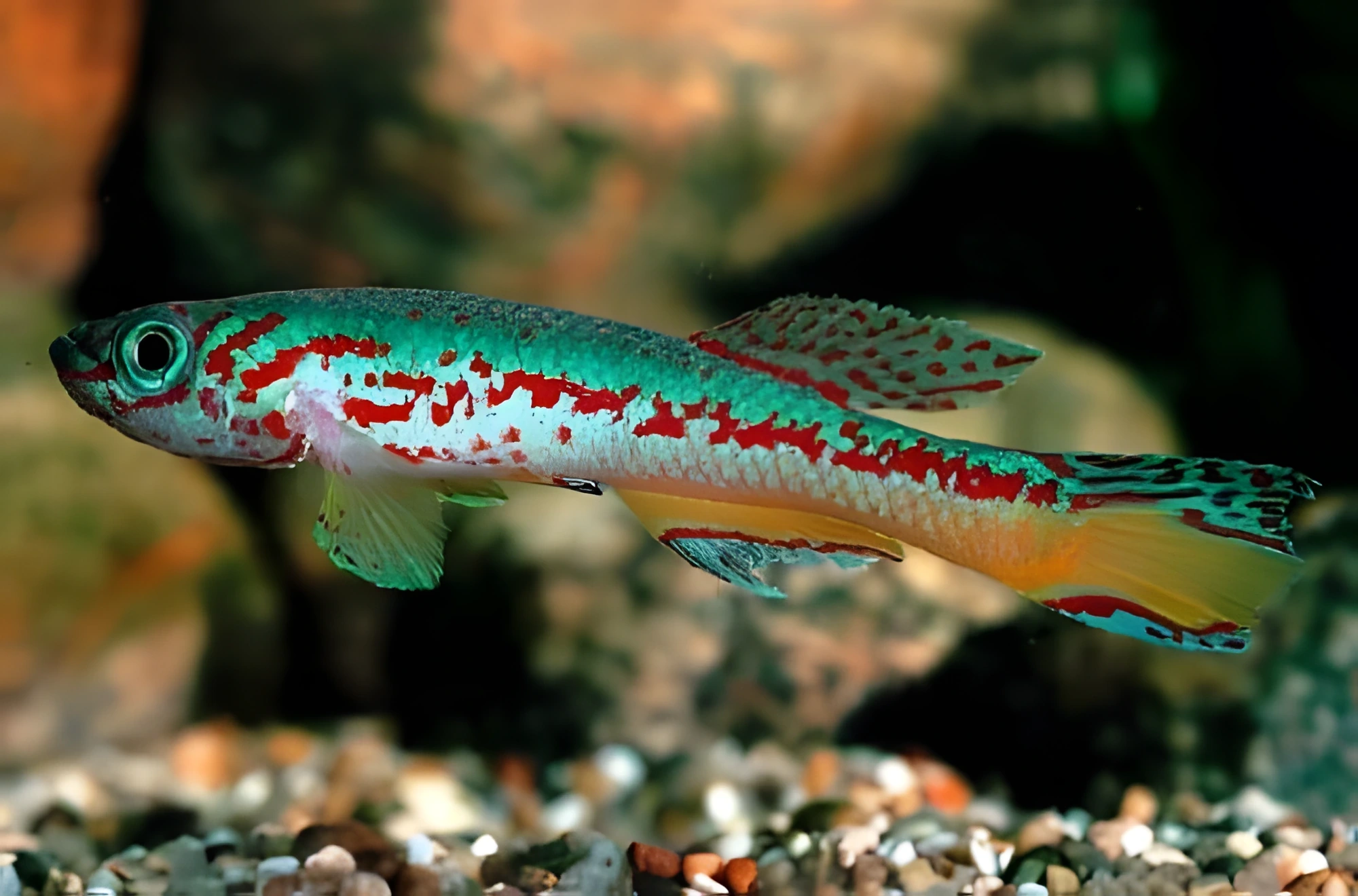
Males of this species grow up to 7 cm in length. Their slender, elongated bodies feature iridescent turquoise or greenish hues. The body is adorned with a pattern of numerous bright red spots, forming dotted lines, and the fins are decorated with a similar ornament. In the lower part of the body, closer to the tail, and along the lower edge of the caudal fin, yellow shades are observed. Females are generally smaller than males and lack their vibrant coloration. Their primary color is silvery, with a slight pale blue tint, and sometimes faint red spots can be seen on their bodies. This species is closely related to Aphyosemion australe, which is found in similar natural conditions.
Habitat
The species is endemic to Cameroon, inhabiting the Sanaga River basin. In nature, it is found in small forest streams and water bodies of the tropical zone. It prefers areas with slow currents, dense vegetation, and a soft, often peaty bottom, which helps maintain an acidic environment.
Behavior and Compatibility
This species is characterized by a peaceful and somewhat shy disposition. In their natural environment, Aphyosemion Amieti live in shoals, finding shelter among lush aquatic vegetation. Based on this, it is recommended to keep a group of 4–5 individuals. A species-specific aquarium would be most favorable for them, but it is possible to introduce a few other small fish of similar size, such as various Tetras or Rasboras.
Care and Maintenance
For a group of 4–5 fish, an aquarium of 30 to 40 liters will be optimal. Its design should actively incorporate aquatic plants, ranging from carpeting species to floating ones. Floating plants will create the necessary shade, so shade-loving species such as ferns, mosses, and Anubias will be appropriate for the lower levels. Natural snags and fallen leaves from certain trees (e.g., beech, oak, or Indian almond) placed on a dark substrate will serve as additional decoration. Predominantly acidic water parameters with low hardness are preferred, although a slight increase in pH above neutral is acceptable. It is important to equip the aquarium with a lid, as Aphyosemion Amieti are prone to jumping out of the water. These fish, originating from swamp biotopes, do not tolerate excessive water movement. In this case, a simple air-driven sponge filter would be an ideal choice. If the aquarium is in a warm and well-lit room, there may be no acute need for additional lighting and a heater. Standard aquarium maintenance includes the following essential procedures: weekly water changes of 15–20% of the volume with fresh water and regular removal of organic waste with substrate cleaning. Detailed information regarding the daily diet should be clarified with the supplier. Some individuals may feed exclusively on live and frozen foods (e.g., Artemia, bloodworms, Daphnia), while others can be accustomed to alternative dry foods.
Diet
It is recommended to clarify the specifics of these fish's daily diet with the supplier. Some individuals may feed exclusively on live and frozen foods, such as Artemia, bloodworms, or Daphnia, while others successfully adapt to alternative dry foods. According to experienced aquarists, breeding Aphyosemion Amieti is a relatively simple process. The best results are usually observed in groups where the number of males is less than that of females. Optimal external conditions for reproduction include medium-hard water with a slightly alkaline pH level and a temperature of 20 to 23°C. A protein-enriched diet, for example, consisting of live foods, effectively stimulates the onset of spawning. For egg-laying, fine-leaved moss clusters, coconut fibers, or specialized artificial substitutes are used as substrate or material at the bottom of the aquarium. After the fish have laid their eggs, the substrate with the eggs is carefully removed and placed in a separate tank with identical water parameters. This tank should be in a dark place and equipped with an air-driven filter. The incubation period can range from 6 to 8 weeks. The hatched fry require microscopic food, such as Artemia nauplii, infusoria, or specialized powdered foods and suspensions.
Breeding and Reproduction
Reproduction of Aphyosemion Amieti is considered straightforward by experienced aquarists. The best results are achieved when keeping groups with more females than males. Optimal water parameters include medium hardness, a slightly alkaline pH range, and a temperature of 20–23°C. To stimulate spawning, a high-protein diet, including live foods, is recommended. Suitable spawning substrates placed on the bottom include fine-leaved mosses, coconut fibers, or their artificial counterparts. After spawning is complete, the substrate is carefully removed and placed in a separate tank with the same water conditions. This tank should be in a darkened place and equipped with an air-driven filter. The incubation period typically lasts from 6 to 8 weeks. The hatched fry require microscopic food, such as Artemia nauplii, infusoria, or specialized powdered foods and suspensions. Sources: Fish Base, Encyclo-Fish.com, killi.co.uk
Diseases
The fish are susceptible to diseases typical for killifish if their keeping conditions are violated. Bacterial infections and fungal lesions are most common when injuries occur or water quality is poor. Sensitivity to water purity is a key factor: the accumulation of organic waste quickly leads to a decrease in immunity. Prevention includes regular water changes, maintaining the temperature regime, and using high-quality live or frozen food.
How to choose
When selecting individuals, attention should be paid to the activity of the fish and the cleanliness of their skin. A healthy fish should have vibrant coloration, tightly pressed fins without signs of edge erosion, and no spots or growths on the body. Avoid purchasing sluggish fish that stay at the surface or bottom, as well as individuals with deformed fins or signs of emaciation. It is recommended to acquire a group of one male and several females to reduce intraspecific aggression.
Frequently asked questions
The essentials: size, tank volume, water parameters and care
How big does Aphyosemion Amieti get?
An adult reaches 7 cm in length. Plan the tank around the maximum size: the fish quickly outgrows a cramped setup.
What size aquarium does Aphyosemion Amieti need?
The minimum recommended volume is 40 L. A smaller tank speeds up nitrate build-up and raises stress levels.
What water parameters does Aphyosemion Amieti need?
Temperature 20–27 °C, pH 5.8–7.2, hardness 5–15 dGH. Stability matters more than exact values: sudden swings are harder on the fish than a small deviation from the ideal.
How long does Aphyosemion Amieti live?
Around 3 years when kept properly. Lifespan depends directly on tank volume, water quality and a varied diet.
Is Aphyosemion Amieti aggressive?
Temperament: peaceful (regular). Keep this in mind when choosing tank mates.
How many Aphyosemion Amieti should be kept together?
Recommended setup: small group (3–4 individuals). Ignoring this is a common cause of stress and disease.
What does Aphyosemion Amieti eat?
Diet type: any (universal). Feed small portions that are finished within a couple of minutes — overfeeding does more harm than underfeeding.
What is the scientific name of Aphyosemion Amieti?
The scientific name of the species is Fundulopanchax amieti, family Nothobranchiidae. It also appears in the literature as: Aphyosemion amieti.