Temperature27 – 30 °C
Natural range
- Northern Peru area
- Peru area
KillifishConservation status: Data deficient DD
Other scientific names: Moema peruensis, Pterolebias peruensis
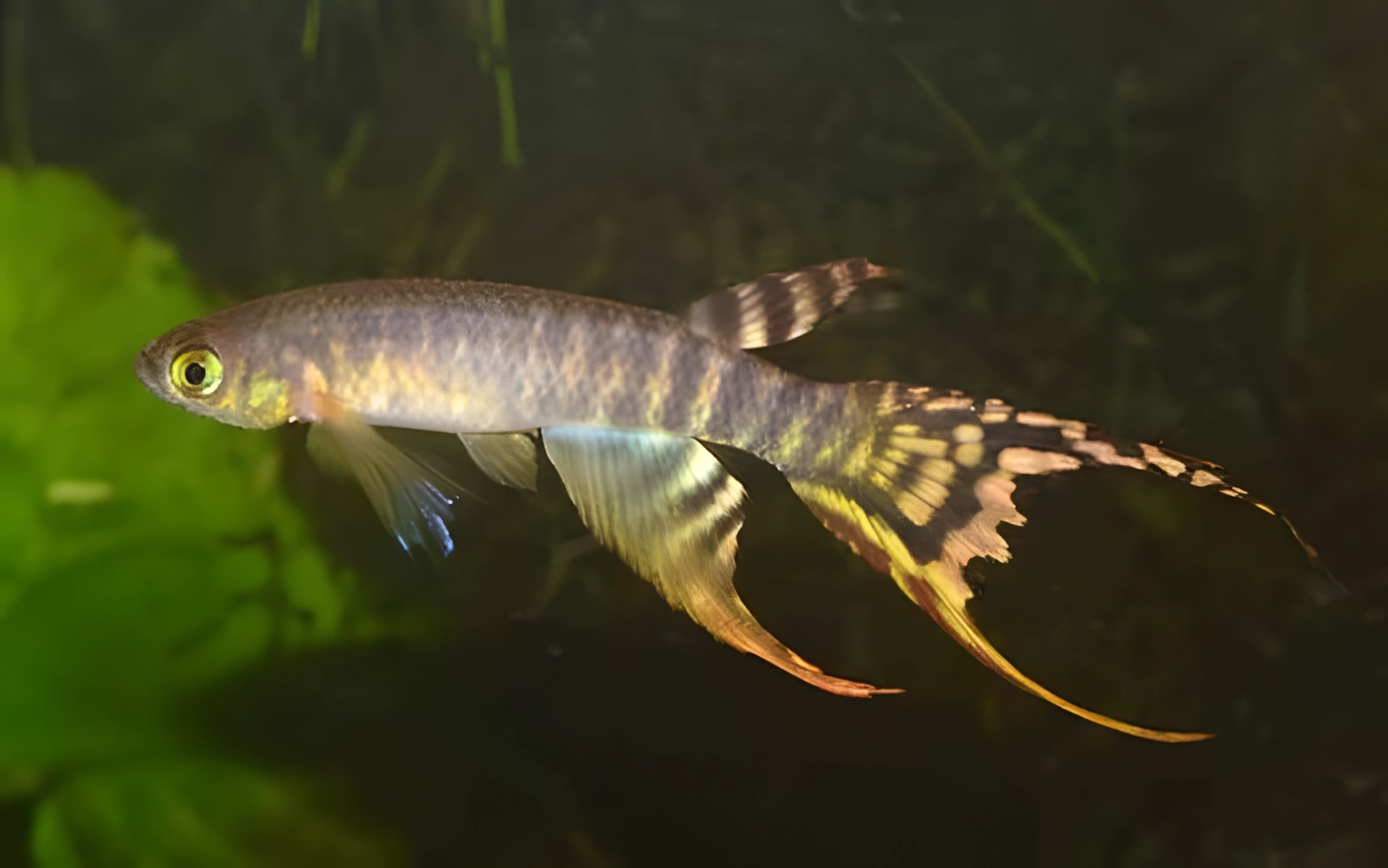
The Peruvian Aphyolebias, scientifically known as Aphyolebias peruensis, belongs to the family Rivulidae. This elegant fish has an elongated body and inhabits the pristine tropical forests of northern Peru. Its life cycle is short, about a year, so fish often arrive in aquariums as eggs, which are remarkably resilient.
- Required aquarium volume
- 50 L
- Size in aquarium
- 10 cm
- Temperature
- 27 – 30 °C
- Temperament
- Peaceful (regular)
Parameters
Water pHSlightly acidic (5) – Slightly alkaline (8)
Water dHSoft (5) – Medium hardness (8)
Water salinityno salt (freshwater)
Size in aquarium10 cm
Lifespan5 years
TemperamentPeaceful (regular)
Toward small fishnot a predator
Required aquarium volume50 L
Lightingdimmed
Substratesoft silted
Water flownone or stagnant (no flow)
FeedingMixed diet (meat + plant-based)
CareSchooling (usually from 5–6 individuals and more)
Description
Adults of this fish can reach a length of up to 10 cm. They have a slender, refined body and prominent, especially in males, large fins. A characteristic feature of the species is large eyes, which is due to the need to navigate in conditions of poor visibility. Aphyolebias peruensis exhibits significant intraspecific variability, so fish from different geographical areas may have substantial differences in coloration. However, the predominant shades are usually gray-yellow and gray-turquoise. Particularly vibrant colors can be observed on the fins and tail. Regardless of color variations, a striped pattern on the body is typical for these fish. In their natural habitat, they live for only one season, as long as the temporary body of water exists. Over 7–8 months, they rapidly pass through all stages of their life cycle, from egg to sexually mature individual. When kept in home aquariums with stable conditions, their lifespan significantly increases, reaching an average of 1.5 years.
Habitat
South America is the native home of this fish, and its natural range is limited to Peru, as the name suggests. These creatures inhabit the northern part of the country, populating small bodies of water in untouched tropical forests. Typically, such bodies of water are shallow puddles on the forest floor or backwaters near rivers, where the bottom is covered with mud, fallen leaves, and branches. The water in them is often murky. These aquatic landscapes are temporary: they form during the rainy season and dry up with the onset of the dry period. Thus, the entire life of the fish is tied to this seasonal cycle.
Behavior and Compatibility
Aphyolebias peruensis typically occurs in groups of its own kind, which is due to the peculiarities of its natural environment. In the wild, coexistence with other species is rare; only occasionally might other killifish species be found. In a home aquarium, cohabitation with fish of comparable size that can adapt to similar conditions is permissible.
Care and Maintenance
The optimal aquarium volume for keeping 3–4 individuals starts from 40–50 liters. If breeding is not the goal, the setup can be quite simple. It is recommended to use a soft, dark substrate, on which a layer of leaves, branches, and snags can be placed. Shade-loving plants can be planted, and floating vegetation can be used on the water surface. Essential equipment includes a simple airlift filter and a heater. Aphyolebias peruensis prefers subdued lighting. Therefore, if the aquarium is in a living room, an additional light source is usually not required. It is extremely important to maintain low water hardness and acidic pH values (around 5.3). The comfortable temperature regime is quite high, ranging from 27–30°C.
Diet
In nature, this species is a predator, feeding on small aquatic invertebrates. In aquarium conditions, the diet should consist mainly of live or frozen foods, such as Daphnia, bloodworms, or glassworms. Acclimation to high-quality dry foods is possible, but they should not form the basis of the diet. Feeding once or twice a day in small portions is recommended.
Breeding and Reproduction
Given the short lifespan of these fish, breeding can be a way to maintain their population in a home aquarium. Initiating spawning is usually not difficult even for beginner aquarists, but preserving the eggs and raising offspring is a more challenging task. Fish reach sexual maturity as early as 4–5 months and readily begin to spawn. To achieve the best breeding results, it is important to provide the fish with a protein-rich diet. Live or frozen foods such as bloodworms, Artemia, Daphnia, or mosquito larvae are preferred. In their natural habitat, eggs are laid deep in soft substrate. When the body of water dries up, the eggs remain in the dried substrate, staying there until the end of the dry season. Similar conditions must be recreated in the aquarium. Therefore, the choice of substrate plays a key role in the breeding process. Soft, fibrous materials, preferably natural, such as coconut fiber or a layer of sphagnum moss, are recommended. While waiting for spawning, the substrate should be regularly siphoned to remove all organic debris. After eggs are found, the substrate is carefully removed. It is advisable to gently rinse it with aquarium water, trying not to damage the eggs and to clean it as much as possible from debris. Then, the substrate is dried to a "slightly damp" state and placed in a container with a perforated lid. This container should be left in a dark place, maintaining a temperature of about 25°C. The incubation period lasts 4 months. It is important to periodically inspect the substrate for mold or fungi, removing affected eggs. It is also necessary to control humidity, slightly moistening the substrate if necessary. After 4 months, the substrate with the eggs is submerged in water. If all conditions have been met, the fry will appear within a few days.
Diseases
No specific species-specific diseases have been described for this representative of the Rivulidae, however, like other seasonal fish, Aphyolebias peruensis is highly sensitive to water quality and keeping conditions. Violation of environmental parameters, especially temperature deviation from the 27–30 °C range or accumulation of organic compounds, quickly leads to weakened immunity and the development of bacterial infections or fungal skin lesions.
The main risk factors include:
- high levels of nitrates and ammonia, provoking damage to gills and skin;
- sharp fluctuations in water chemistry, causing stress and subsequent secondary infections;
- failure to observe quarantine when introducing new individuals, which increases the likelihood of parasitic infection.
Disease prevention is based on strict control of water parameters and regular water changes. Due to the difficulty of adapting the species to aquarium conditions, any signs of lethargy or refusal to feed require an immediate check of the habitat conditions.
How to choose
When purchasing, choose active individuals without visible fin damage or signs of emaciation. In the store, it is important to assess the fish's behavior: healthy specimens show interest in surrounding objects and do not exhibit apathy. It should be noted that the species belongs to seasonal (annual) fish, so when acquiring them, it is necessary to clarify the age of the individuals, as their life cycle in captivity is limited.
Frequently asked questions
The essentials: size, tank volume, water parameters and care
How big does Peruvian Aphyolebias get?
An adult reaches 10 cm in length. Plan the tank around the maximum size: the fish quickly outgrows a cramped setup.
What size aquarium does Peruvian Aphyolebias need?
The minimum recommended volume is 50 L. A smaller tank speeds up nitrate build-up and raises stress levels.
What water parameters does Peruvian Aphyolebias need?
Temperature 27–30 °C, pH 5–8, hardness 5–8 dGH. Stability matters more than exact values: sudden swings are harder on the fish than a small deviation from the ideal.
How long does Peruvian Aphyolebias live?
Around 5 years when kept properly. Lifespan depends directly on tank volume, water quality and a varied diet.
Is Peruvian Aphyolebias aggressive?
Temperament: peaceful (regular). Keep this in mind when choosing tank mates.
How many Peruvian Aphyolebias should be kept together?
Recommended setup: schooling (usually from 5–6 individuals and more). Ignoring this is a common cause of stress and disease.
What does Peruvian Aphyolebias eat?
Diet type: mixed diet (meat + plant-based). Feed small portions that are finished within a couple of minutes — overfeeding does more harm than underfeeding.
What is the scientific name of Peruvian Aphyolebias?
The scientific name of the species is Aphyolebias peruensis, family Rivulidae. It also appears in the literature as: Moema peruensis, Pterolebias peruensis.