Temperature20 – 27 °C
Natural range
- Amazon River Basin
- Paraná River Basin
- Brazil area
- Argentina area
CharacinsConservation status: Least concern LC
Other scientific names: Aphyocharax avary, Chirodon alburnus
Aphyocharax alburnus, also known as the Gold-crown Tetra, belongs to the family Characidae. Its natural habitat is located in South America, extending from central Brazil to northern Argentina. This species prefers to inhabit various biotopes, predominantly found in shallow river areas, backwaters, swamps, and other shallow bodies of water where vegetation is abundant.
- Required aquarium volume
- 80 L
- Size in aquarium
- 6 – 8 cm
- Temperature
- 20 – 27 °C
- Temperament
- Peaceful, active/mobile
Parameters
Water pHNeutral (7) – Neutral (7.5)
Water dHSoft (6) – Very hard (20)
Water salinityno salt (freshwater)
Size in aquarium6 – 8 cm
Lifespan5 years
TemperamentPeaceful, active/mobile
Toward small fishnot a predator
Required aquarium volume80 L
Lightingdimmed or moderate
Substrateany, but dark
Water flowweak
FeedingAny (universal)
CareMedium group (6–8 individuals)
Description
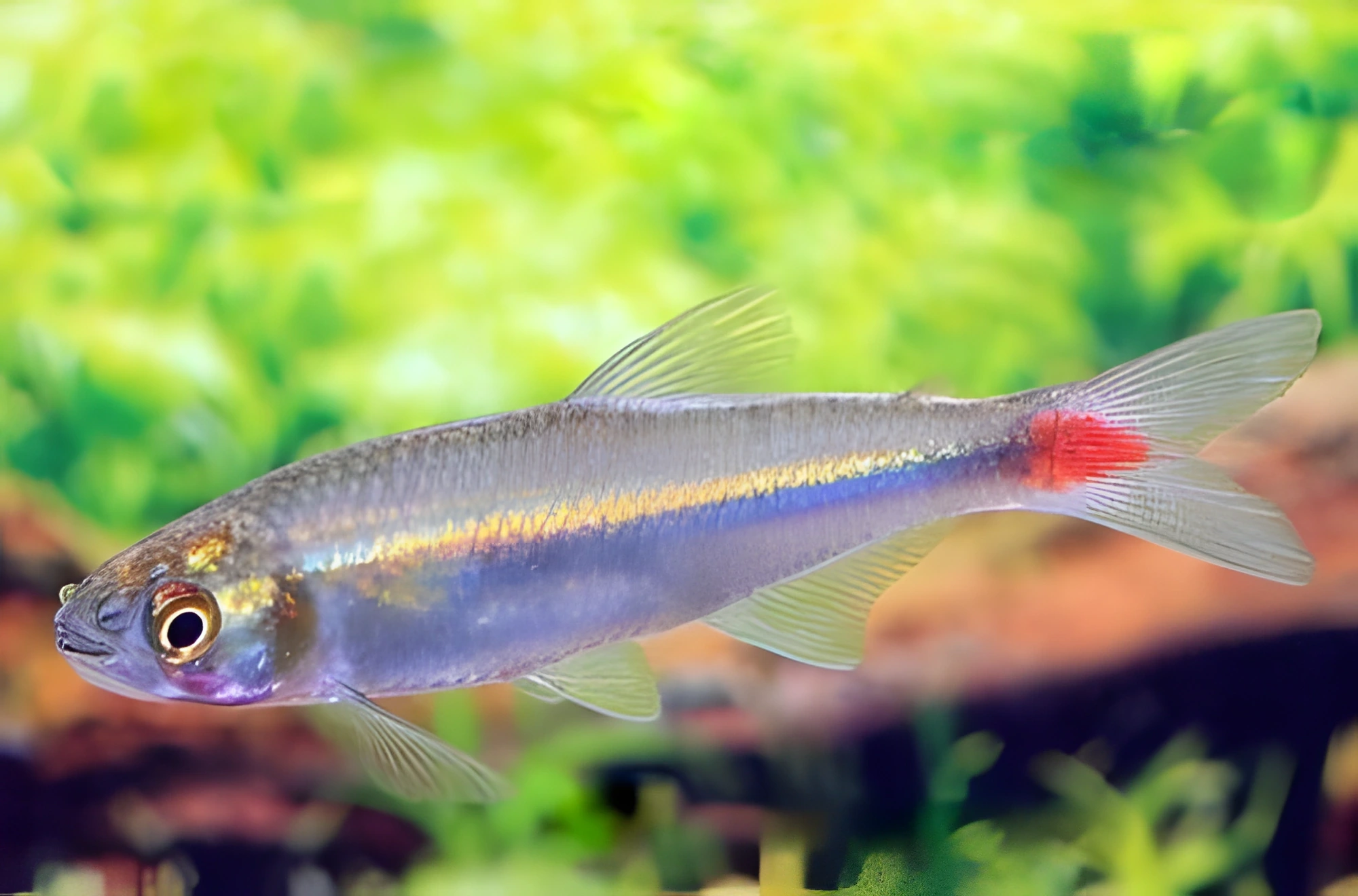
Adults of this fish reach a length of about 6 cm. The body is slender and elongated, silvery in coloration with a slight blue tint, and the tail is bright red. Sexual dimorphism in the species is insignificant. Males appear more refined, while females seem somewhat larger. Aphyocharax alburnus is often confused with the Red-fin Tetra, which is a related species and has a similar body shape, but in addition to a red tail, it also has red fins.
Habitat
Aphyocharax alburnus inhabits the Amazon and Paraná river basins in South America, including Brazil, Argentina, and Paraguay. In nature, these fish prefer to stay in small rivers, streams, and backwaters with moderate currents. They are often found in coastal areas with sandy or silty bottoms, dense aquatic vegetation, and the presence of submerged snags that provide shelter.
Behavior and Compatibility
This fish is distinguished by its peaceful nature and active behavior. During courtship, males may compete with each other, but their skirmishes do not result in injury; all their activity is limited to a "display of strength." It is recommended to keep them in a group of 6–8 individuals. They get along well with most other species of comparable size and similar temperament.
Care and Maintenance
For a school of 6–8 individuals, an aquarium of at least 80 liters is desirable. The decor can be anything, the main thing is to ensure a balance between open spaces for active swimming and corners for shelter. Thickets of aquatic plants, snags, or various decorative elements are suitable for this purpose. These fish are highly mobile; during play or when sensing danger, they tend to jump out of the water, so a lid on the aquarium is mandatory. The wide range of natural distribution has allowed this species to adapt well to diverse conditions. Thus, the fish can live in a fairly wide range of temperature and hydrochemical parameters. Aquarium care includes standard procedures: weekly partial water changes, removal of organic waste (such as uneaten food and excrement), cleaning of glass and decor elements (as needed), and equipment maintenance. The daily diet is based on popular dry foods. In addition, it is recommended to offer live or frozen foods several times a week, such as Artemia, bloodworms, or Daphnia.
Diet
The daily diet is based on popular dry foods. In addition, it is advisable to offer live or frozen delicacies several times a week, such as Artemia nauplii, bloodworms, or Daphnia. These are peaceful and active creatures. During courtship displays, males compete for the attention of females, but their interaction is purely demonstrative and does not lead to conflict. It is desirable to keep a group of 6–8 individuals. This species is well compatible with most fish of similar size and temperament.
Breeding and Reproduction
Breeding is possible in a spawning tank with a separator net and fine-leaved plants. An increase in temperature and frequent water changes serve as a stimulus. Females lay eggs among plants, often jumping above the water surface. Since parental instincts are absent and the fish are prone to eating eggs, the parents must be removed immediately after spawning. The incubation period lasts about 48 hours, after which the fry begin to feed on rotifers or infusoria.
Diseases
The species has moderate resilience but is sensitive to sudden changes in water parameters and low oxygen content. Under stress caused by noise or poor conditions, the fish lose their bright coloration and become susceptible to infections. Prevention includes maintaining cleanliness, regular aeration, and avoiding sudden loud noises near the aquarium, as the fish tend to be timid.
How to choose
When purchasing, choose active individuals without external damage. Healthy fish should have bright coloration and steady breathing. It is important to avoid specimens with signs of emaciation, clamped fins, or spots on the body. Since Aphyocharax are schooling fish, it is recommended to acquire a group of 6-10 individuals to reduce stress levels and prevent aggressive behavior towards tankmates.
Frequently asked questions
The essentials: size, tank volume, water parameters and care
How big does Aphyocharax alburnus get?
An adult reaches 6–8 cm in length. Plan the tank around the maximum size: the fish quickly outgrows a cramped setup.
What size aquarium does Aphyocharax alburnus need?
The minimum recommended volume is 80 L. A smaller tank speeds up nitrate build-up and raises stress levels.
What water parameters does Aphyocharax alburnus need?
Temperature 20–27 °C, pH 7–7.5, hardness 6–20 dGH. Stability matters more than exact values: sudden swings are harder on the fish than a small deviation from the ideal.
How long does Aphyocharax alburnus live?
Around 5 years when kept properly. Lifespan depends directly on tank volume, water quality and a varied diet.
Is Aphyocharax alburnus aggressive?
Temperament: peaceful, active/mobile. Keep this in mind when choosing tank mates.
How many Aphyocharax alburnus should be kept together?
Recommended setup: medium group (6–8 individuals). Ignoring this is a common cause of stress and disease.
What does Aphyocharax alburnus eat?
Diet type: any (universal). Feed small portions that are finished within a couple of minutes — overfeeding does more harm than underfeeding.
What is the scientific name of Aphyocharax alburnus?
The scientific name of the species is Aphyocharax alburnus, family Characidae. It also appears in the literature as: Aphyocharax avary, Chirodon alburnus.